
Microeconomics examines the decisions of individual consumers and firms and the functioning of particular markets. Macroeconomics looks at the economy as a whole, studying outcomes such as inflation, unemployment, national income and economic growth.
For example, asking why tomato prices rose in one market is mainly a microeconomic question. Asking why the overall price level is rising across India is a macroeconomic question. Both branches study the same economy, but at different levels of analysis.
What Is Microeconomics?
Microeconomics studies how individuals, households and businesses make choices when resources are limited, and how those choices interact in markets. It helps explain what consumers buy, how firms decide what and how much to produce, and how prices and quantities are determined.
Its main topics include demand and supply, consumer choice, production and costs, market structures such as competition and monopoly, and the effects of taxes or subsidies on specific markets. Microeconomics also studies market failures, including externalities and market power.
The word “micro” does not mean that the question must concern a small city or a tiny business. A nationwide market for a particular product can still be studied using microeconomics.
Examples of Microeconomics
- Why does the price of tomatoes rise when supplies to a local market fall?
- How does a restaurant decide whether hiring another employee is worthwhile?
- How does a tax on sugary drinks affect the price paid by buyers and the quantity sold?
- How does a company change its prices when a new competitor enters its market?
- How might an electricity subsidy change a household’s electricity consumption?
Each question focuses on the behaviour of particular decision-makers or the outcome in a specific market.
What Is Macroeconomics?
Macroeconomics studies economy-wide outcomes and how they change over time. Instead of the price of one product, it examines the overall price level. Instead of hiring at one company, it looks at total employment and unemployment across an economy.
Its central topics include gross domestic product (GDP), economic growth, inflation, aggregate demand and supply, unemployment, government budgets, monetary policy and the external sector. Macroeconomic analysis helps policymakers understand recessions, inflationary pressures and long-term growth.
Examples of Macroeconomics
- Why is India’s overall inflation rate rising or falling?
- What explains changes in India’s GDP growth?
- How can a change in the RBI’s policy interest rate affect economy-wide spending and inflation?
- Why does the national unemployment rate change over the business cycle?
- How might higher government spending influence total output and the fiscal deficit?
These questions concern aggregates or developments affecting the economy as a whole. They are examples of questions, not claims about current economic conditions.
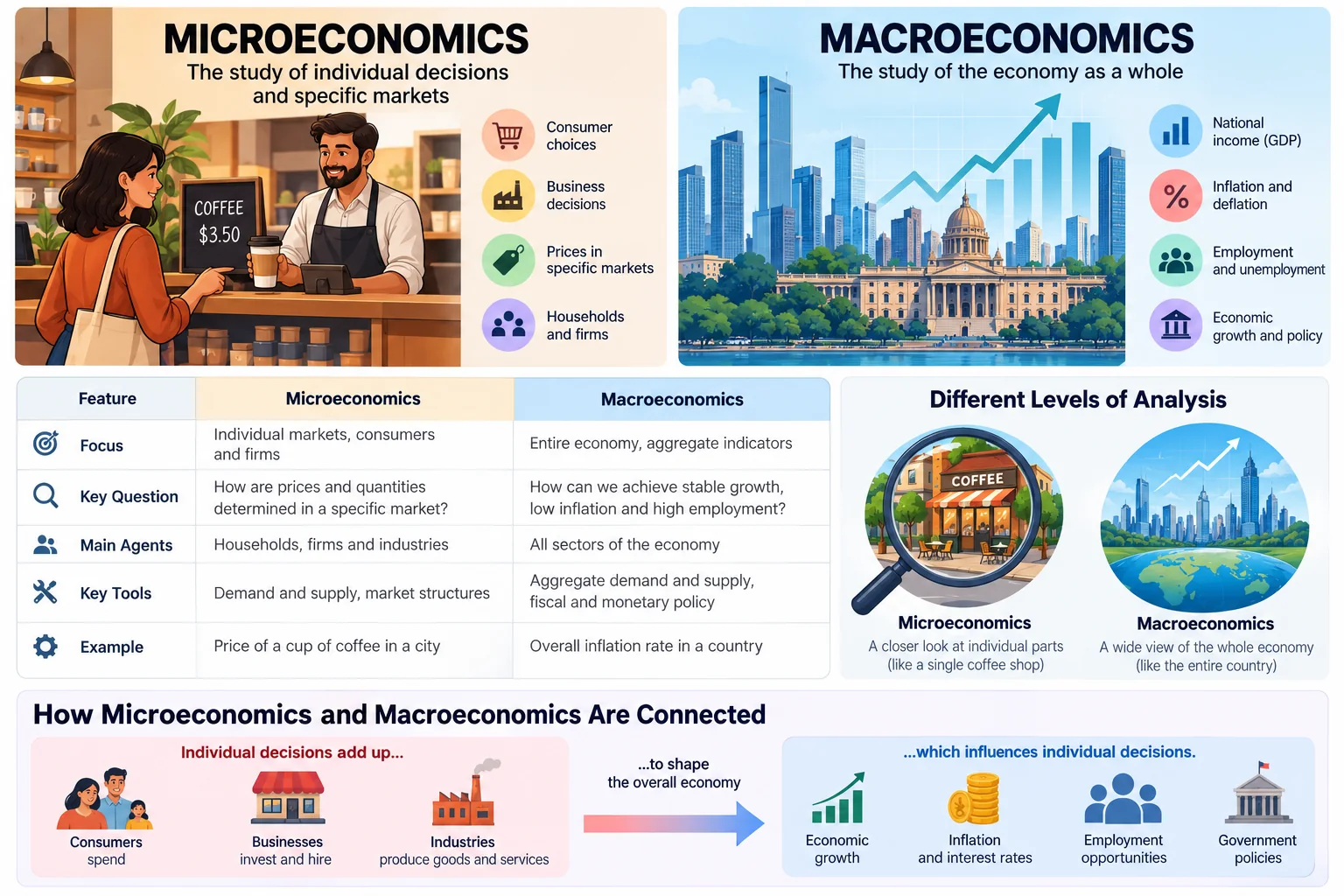
Microeconomics vs. Macroeconomics: Key Differences
The most useful distinction is the unit of analysis: an individual decision or market in microeconomics, versus economy-wide outcomes in macroeconomics.
| Aspect | Microeconomics | Macroeconomics |
|---|---|---|
| Main focus | Consumers, firms and individual markets | The economy as a whole |
| Typical question | Why did the price of one product change? | Why did the overall inflation rate change? |
| Prices studied | Price of a good, service or factor of production | General price level and inflation |
| Output studied | Output of a firm or a particular industry | National output and GDP |
| Employment studied | Hiring and wages in a firm or labour market | Total employment and unemployment |
| Demand studied | Demand for a particular good or service | Aggregate demand for goods and services |
| Common tools | Demand and supply, elasticity, consumer and producer theory, market structures | GDP accounting, aggregate demand and supply, growth and business-cycle models |
| Typical policy question | How would a product-specific tax affect buyers and sellers? | How might fiscal or monetary policy affect inflation, output and employment? |
The Same Event Can Have Microeconomic and Macroeconomic Effects
Microeconomics and macroeconomics are not two separate worlds. A single development can be examined from both perspectives.
| Event | Microeconomic perspective | Macroeconomic perspective |
|---|---|---|
| An increase in oil prices | How do higher fuel costs affect a transport company’s prices and a household’s travel choices? | Could more expensive energy contribute to overall inflation or affect the trade balance? |
| A change in the RBI’s policy rate | How does the borrowing cost influence a homebuyer’s or firm’s decision? | How might changes in borrowing and spending influence inflation and output? |
| A tax on a particular product | How does the tax affect that product’s price, quantity sold and the burden on buyers and sellers? | If substantial, how does the tax contribute to government revenue or the broader price index? |
This is why “micro = local” and “macro = national” is an unreliable shortcut. The distinction depends on what is being explained, not merely the geographical size of the issue.
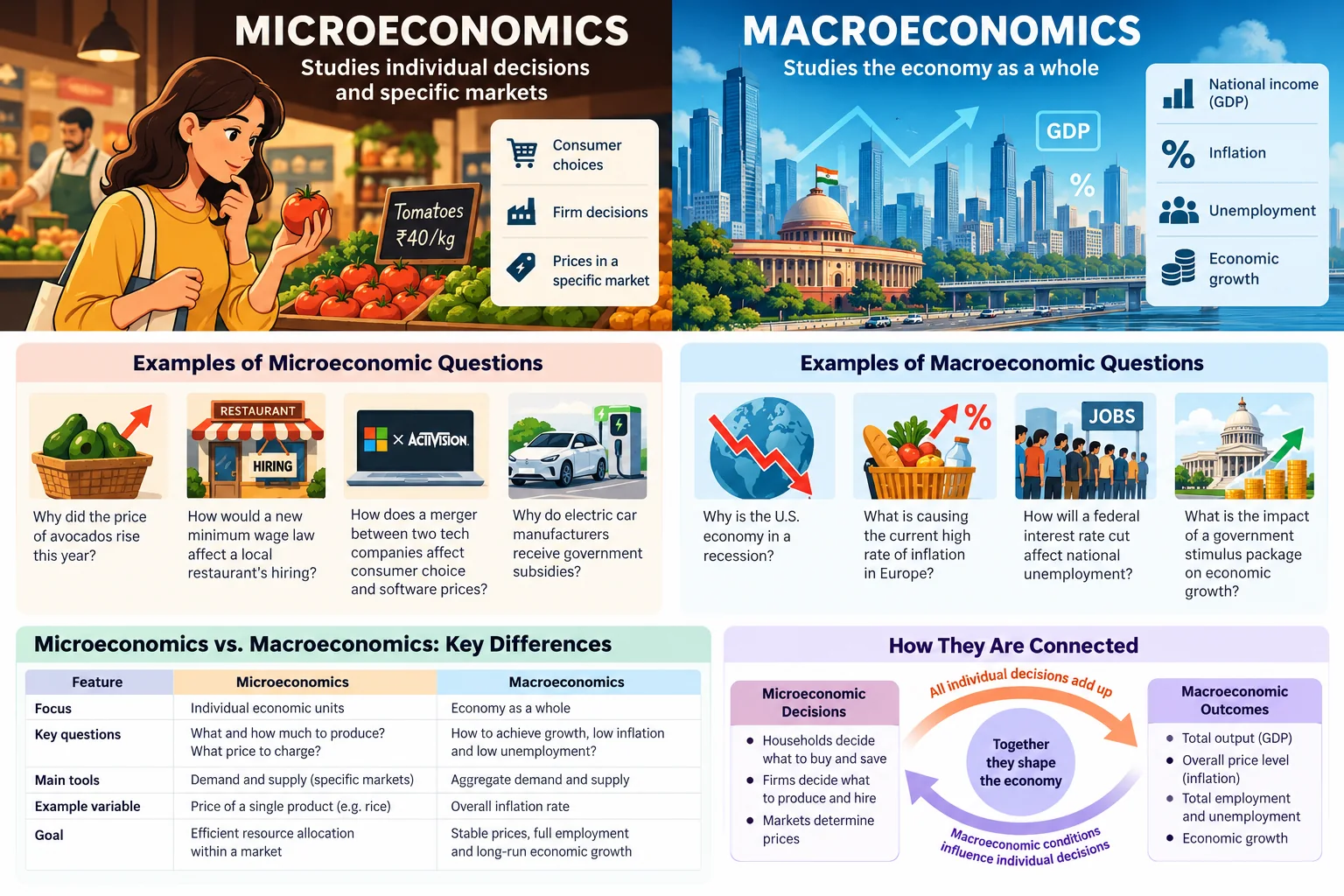
How Are Microeconomics and Macroeconomics Connected?
Macroeconomic outcomes emerge from the decisions and interactions of many households, firms, financial institutions and governments. At the same time, economy-wide conditions influence those individual decisions.
Consider interest rates. When borrowing becomes more expensive, a household may delay buying a car and a firm may postpone investment. If many households and firms respond in similar ways, aggregate spending can slow. But economy-wide results also depend on expectations, financial conditions, government policy and other forces. They are not always a simple sum of isolated decisions.
Likewise, a slowdown in the overall economy can reduce demand for a particular firm’s products. That firm may then adjust production, pricing or hiring. Microeconomic behaviour and macroeconomic conditions influence each other.
How to Tell Whether a Question Is Micro or Macro
When a question is confusing, try these three checks:
- Identify the outcome: Is the question about a specific price, firm, consumer or market, or about GDP, economy-wide inflation or total employment?
- Look at the mechanism: Is it asking how individual buyers and sellers respond to incentives, or why an aggregate economic variable changes?
- Do not rely on geography alone: A nationwide market for wheat can be a microeconomic topic, while a recession in a small country is a macroeconomic topic.
A quick memory aid: the price of one product is typically microeconomic; the movement of prices across the economy is macroeconomic.
Frequently Asked Questions
Is inflation a microeconomic or macroeconomic topic?
Inflation, meaning a sustained rise in the overall price level, is mainly a macroeconomic topic. Changes in the price of a particular good are often studied using microeconomics. An increase in one product’s price does not, by itself, establish economy-wide inflation.
Is unemployment studied in microeconomics or macroeconomics?
Both. The hiring choices of an individual firm and wage-setting in a particular labour market are microeconomic questions. Changes in the national unemployment rate are macroeconomic questions.
Is every government policy a macroeconomic issue?
No. The effect of a product-specific tax on buyers and sellers is a microeconomic question. The effects of the government’s overall taxation and spending on total demand, debt or inflation are macroeconomic questions.
Which should I study first: microeconomics or macroeconomics?
For beginners, microeconomics often provides a useful foundation for understanding choices, markets and incentives. Macroeconomics then builds on this foundation to explain aggregate outcomes. For an entrance exam, follow the actual syllabus rather than assuming one branch is always more important.
Where to Go Next
If you are preparing for an economics entrance exam, check the topics covered in the CUET PG Economics syllabus and the IIT JAM Economics syllabus. Both typically require a clear understanding of microeconomic and macroeconomic concepts.