CUET PG Economics Syllabus (COQP10) is the starting point for anyone preparing for CUET PG MA Economics admissions. But simply downloading the PDF is not enough. The official document is compact, several headings cover much more material than their wording suggests, and different parts of the syllabus require very different preparation methods.
This guide gives you the complete CUET PG Economics syllabus, explains how to read it, shows what each block means for preparation, and connects the syllabus to PYQs, books, study plans and mock-test practice.
CUET PG Economics syllabus: quick exam facts
The CUET PG Economics syllabus is organised under paper code COQP10.Use this page as your working syllabus checklist for preparation, revision and practice.
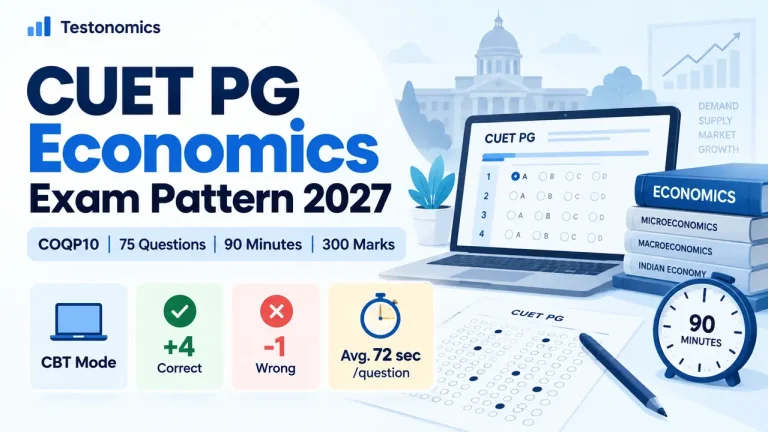
Quick exam facts from the official syllabus: 75 questions, all compulsory, all based on subject-specific knowledge, with questions available in English and Hindi.
On this page
- What is CUET PG Economics (COQP10)?
- How the syllabus is structured
- Complete subject-wise syllabus
- How to prepare from the syllabus
- Subject-wise preparation approach
- CUET PG, MA Economics entrance exams and IIT JAM Economics
- Common syllabus-preparation mistakes
- Continue your preparation
- Upcoming guides we will link here
- FAQs
What is CUET PG Economics (COQP10)?
CUET PG Economics is the Economics paper in the Common University Entrance Test for postgraduate admissions conducted by the National Testing Agency. The paper code is COQP10. Students use the score for admission to eligible postgraduate Economics programmes offered by participating universities and institutions.
If your broader goal is an MA or M.Sc. in Economics, CUET is one route within the wider set of MA Economics entrance exams. Other institutions may use separate examinations. For example, IIT JAM Economics has its own syllabus and exam structure.
For a broader overview of the exam, admissions, preparation path and resources, read our CUET PG Economics 2027 guide.
How the CUET PG Economics syllabus is structured
The official syllabus is best understood as seven broad blocks. Do not confuse a short heading with a small topic. “Microeconomics”, for example, spans consumer theory, production, market structures, general equilibrium, efficiency and welfare.
The seven blocks are: Microeconomics; Macroeconomics; Money and Inflation; Consumption and Investment Function; Statistical Methods in Economics; Mathematical Methods in Economics; and Indian Economy (with public economics and international trade topics included in the same official block).

- Microeconomics
- Macroeconomics
- Money and Inflation
- Consumption, Investment, Open Economy and Growth
- Statistical Methods in Economics
- Mathematical Methods in Economics
- Indian Economy, Public Economics and International Trade
Complete CUET PG Economics syllabus: subject-wise topics
Use the expandable sections below as a clean checklist. The wording is organised for readability while preserving the scope of the official COQP10 syllabus.
- Consumer theory: demand, utility, indifference curves, revealed preference and consumer surplus.
- Production theory: production functions, law of variable proportions, returns to scale and cost concepts.
- Markets: perfect competition and imperfect competition, including monopoly, price discrimination, monopolistic competition, duopoly and oligopoly models.
- General equilibrium, efficiency and welfare: exchange and production efficiency, overall efficiency, welfare economics and externalities.
- National income accounting.
- Income and output determination: aggregate demand and aggregate supply, effective demand, and classical and Keynesian approaches.
- Demand and supply of money, money multiplier, high-powered money, credit creation, RBI and commercial banks, quantity theories of money and the Phillips Curve.
- Monetary and fiscal policy in India and their role.
- Permanent income, relative income and life-cycle hypotheses; business fixed investment, residential investment, inventory investment, multiplier and accelerator.
- Open-economy models: Mundell-Fleming, IS-LM-BP framework, balance of payments, exchange-rate determination and purchasing power parity.
- Economic growth: Harrod-Domar and Solow models.
- Mean, median, mode, dispersion, skewness, quartile deviation, average deviation and standard deviation.
- Correlation.
- Simple regression, probability distributions and sampling.
- Sets and vectors.
- Functions of one and several real variables.
- Single-variable and multivariable optimisation.
- Integration.
- Difference equations.
- Determinants and matrices.
- Linear programming and probability.
- Differential equations.
- Colonial economy: national income, population and occupational structure.
- Agriculture: agrarian structure and land relations; markets and institutions; credit, commerce, technology, productivity and famines.
- Railways and industry: de-industrialisation debate, entrepreneurship, interwar industrialisation, constraints to industrial breakthrough and labour relations.
- Economy and the imperial state: imperial priorities, drain of wealth, international trade and capital flows, colonial fiscal policy and changes/continuities.
- New Economic Policy.
- Public economics: public/private goods, externalities, budgets, deficits, public debt and fiscal federalism in India.
- Taxation: economic effects, deadweight loss, efficiency/equity, tax incidence and optimal taxation.
- International trade: Adam Smith, Ricardo, Heckscher-Ohlin and new trade theories.
How to prepare from the syllabus

A common mistake is to treat the syllabus as a list to “finish”. A better approach is to turn each line into a preparation unit and connect it to concepts, definitions, equations, diagrams, factual associations, PYQs and practice questions.
- Make a master checklist. Break every syllabus line into smaller subtopics and mark them as not started, learning, revised or test-ready.
- Learn concepts before shortcuts. CUET questions can move from a definition to a numerical application or a factual association within the same subject.
- Do not ignore definitions in Mathematical Economics. Terms such as convex/concave functions, optimisation conditions, matrices and difference equations can be tested directly.
- Maintain factual sheets. Indian Economy, economic history, institutions, economists, books, theories and chronology deserve short revision sheets. Link each fact to its surrounding concept instead of memorising isolated trivia.
- Use previous-year papers to calibrate depth. The syllabus tells you what can be tested; CUET PG Economics PYQs show how NTA has actually framed questions.
- Move from learning to timed practice. Once coverage is adequate, use mixed MCQs and full-length mocks to improve retrieval, accuracy and decision-making under time pressure.
For the complete sequence from concept-building to revision and tests, see our CUET PG Economics preparation guide and six-month CUET PG Economics study plan.
Subject-wise preparation approach
The syllabus should not be studied with one uniform method. Concept-heavy, mathematical and fact-heavy areas need different workflows.
If you are starting with the basics, see our microeconomics vs. macroeconomics explainer for definitions, practical examples and the key differences before moving into these syllabus topics.
Microeconomics
Macroeconomics
Mathematical Methods
Statistics
Indian Economy
We are developing separate subject guides for Microeconomics, Macroeconomics, Mathematical Methods, Statistics and Indian Economy. These will be linked from this section as they are published.
CUET PG MA Economics, other MA Economics entrance exams and IIT JAM Economics
If you are preparing for more than one MA Economics entrance exam, do not build completely separate preparation systems from day one. Core Microeconomics, Macroeconomics and quantitative methods create a shared foundation across several exams.
However, the boundaries are not identical. CUET PG MA Economics preparation must remain anchored to COQP10 and its PYQ pattern, while IIT JAM Economics has a separate official syllabus and its own exam style. Use our IIT JAM Economics syllabus page if you are targeting both.
For students beginning much earlier, we are also preparing a 15-Month MA Economics Entrance Preparation Plan: Build Strong Foundations. That guide will focus on learners whose undergraduate curriculum has been less rigorous, or who want to rebuild fundamentals before moving into entrance-specific practice.
Common mistakes while using the syllabus
- Reading topic names too narrowly. “Consumer theory” is not one chapter; it includes multiple models and tools.
- Ignoring factual questions. Even students who are strong in Mathematics can lose marks when they neglect chronology, economists, institutions, books, policy facts and economic history.
- Using only one textbook. No single book maps perfectly onto the CUET syllabus. Use a focused CUET PG Economics booklist rather than reading every recommended text cover-to-cover.
- Memorising PYQ answers without learning the topic. Treat each PYQ as a signal about a broader concept that may reappear in a different form.
- Delaying revision and tests. Coverage without repeated retrieval quickly becomes passive familiarity.
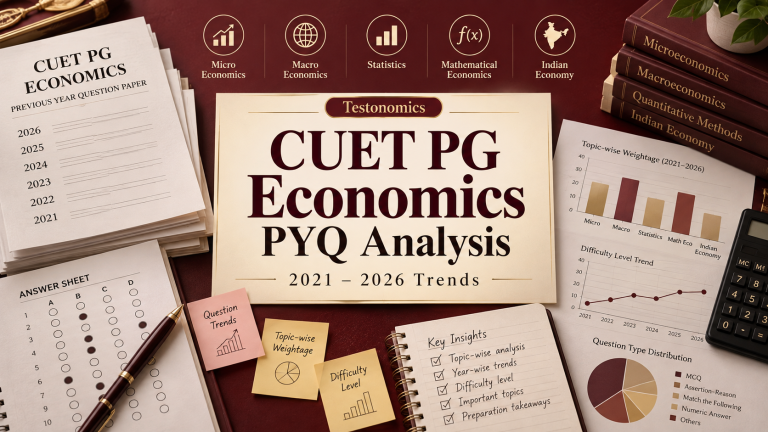
Our CUET PG Economics PYQ analysis helps you see which areas have been tested repeatedly and where factual, conceptual and quantitative questions tend to appear.
Continue your preparation
Once you understand the syllabus, the next step should depend on your stage: build concepts, analyse PYQs, organise time, or start timed practice.
Preparation Guide
6-Month Study Plan
Previous Year Papers
PYQ Analysis
CUET PG Economics Books
High-Rated Test Series
Upcoming guides we will connect to this syllabus page
This page will also become the anchor for a few focused guides that deserve their own treatment:
- CUET PG Economics Important Topics: PYQ Based Priorities — a prioritisation layer built from previous-paper patterns without confusing “important” with “only important”.
- How to Use CUET PG Economics PYQs for Preparation — how to turn each previous question into a topic checklist, not just an answer key.
- CUET PG Economics Exam Pattern: COQP10 Questions and Strategy — a dedicated guide to paper structure, marking scheme and attempt strategy.
- CUET PG Economics vs IIT JAM Economics: Syllabus and Strategy — for students preparing for both exams and looking to combine the common foundation efficiently.
- Subject-wise guides for Microeconomics, Macroeconomics, Mathematical Methods, Statistics and Indian Economy.
We will add contextual links here as each article goes live rather than inserting dead placeholders now.
Stay connected with MA Economics entrance updates
Join our Telegram channel for CUET PG Economics, IIT JAM Economics and wider MA Economics entrance updates, resources and new article releases.
CUET PG Economics Syllabus FAQs
Final takeaway
The CUET PG Economics syllabus should be your boundary, but not your entire strategy. Use it to define coverage, PYQs to understand depth, books to learn the concepts, and repeated revision plus mock tests to convert knowledge into exam performance.
If you are starting now, begin with the CUET PG Economics preparation guide. If your basics are already in place, move directly to previous-year papers and the CUET PG Economics Test Series.