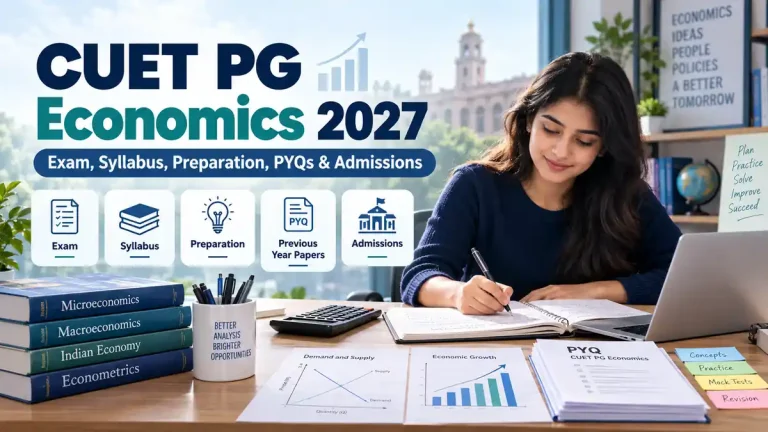
If you are preparing for CUET PG Economics 2027, it helps to first understand the exam as a complete system rather than treating preparation as a collection of disconnected topics. You need to know what the paper tests, how the syllabus is organised, which resources deserve your time, how previous year questions should shape your preparation, and how the exam connects to MA Economics admissions.
This page is designed as the main Testonomics hub for CUET PG Economics. Use it to understand the exam and then move to the detailed guides linked throughout the article.
Students searching for MA Economics entrance exams often come across several routes, including CUET PG MA Economics, IIT JAM Economics and institute-specific admission processes. CUET has become an important route for postgraduate admissions, but the right preparation strategy begins with knowing exactly what the Economics paper expects.
What is CUET PG Economics?
CUET PG is conducted by the National Testing Agency for admission to postgraduate programmes offered by participating universities and institutions. For Economics, the relevant test paper code in the latest confirmed NTA material is COQP10.
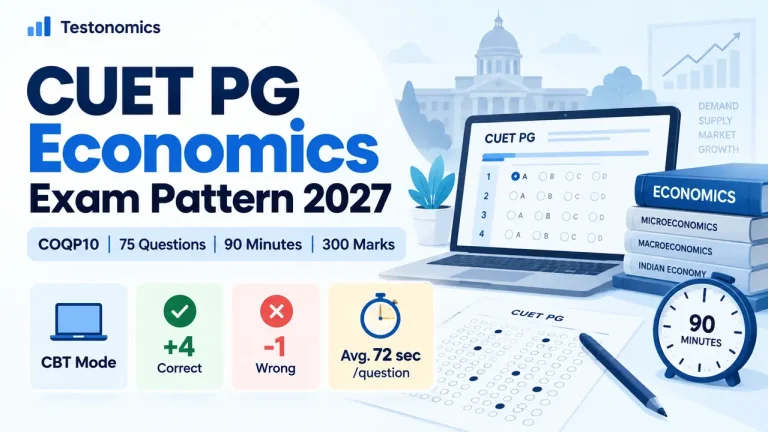
For the 2026 cycle, NTA listed Economics under COQP10 and prescribed a paper with 75 compulsory questions, all based on subject-specific knowledge. For the full format, marking scheme and timing strategy, see our CUET PG Economics exam pattern guide. The paper was bilingual in English and Hindi. As of September 2026, the 2027 bulletin has not yet been issued, so these 2026 rules are best treated as the planning baseline rather than assumed to be final for 2027.
The most important implication is simple: this is not an exam you should prepare for only by memorising definitions. The syllabus spans economic theory, mathematics, statistics, Indian economy and related areas, so preparation needs both conceptual understanding and the ability to solve objective questions efficiently.
CUET PG Economics syllabus: what should you prepare?
The CUET PG Economics syllabus is broad enough that students need a structured coverage plan. The latest confirmed syllabus includes areas such as Microeconomics, Macroeconomics, Money and Inflation, Consumption and Investment, Open Economy Macroeconomics, Economic Growth, Statistics and other core areas of Economics.
Before making a timetable, read our detailed CUET PG Economics Syllabus guide. It is useful not merely as a checklist, but as the starting point for deciding what you already know, what needs revision and which areas require fresh study.
A common mistake is to spend too much time on favourite subjects while leaving weaker sections until the end. A better approach is to divide the syllabus into three buckets: topics you can revise quickly, topics that need conceptual rebuilding, and topics that need repeated numerical or MCQ practice.
How should you prepare for CUET PG Economics 2027?
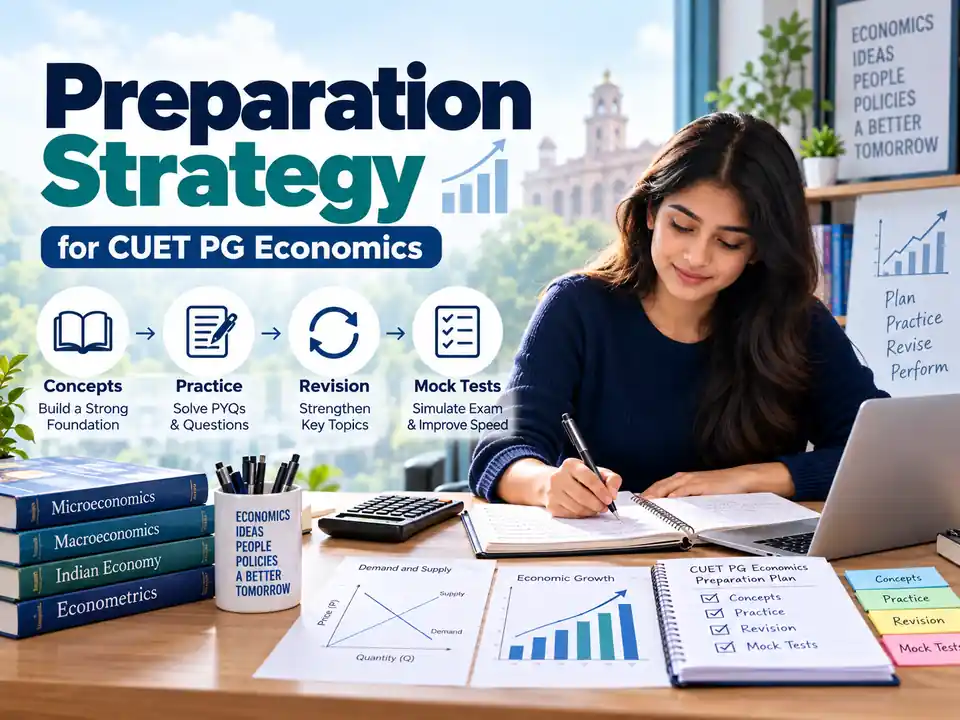
Your preparation should move through four stages: syllabus coverage, topic-wise practice, PYQ analysis and full-length testing. The balance between these stages changes as the exam gets closer.
If you want the detailed subject order, revision framework, mock-test strategy and preparation mistakes to avoid, use our separate guide on CUET PG Economics Preparation 2027. This hub intentionally gives you the full map; the preparation article goes deeper into execution.
1. Build concepts before chasing MCQ volume
Objective exams reward speed, but speed without conceptual clarity is fragile. In Microeconomics, for example, knowing a formula is not enough if you cannot identify the assumptions behind it. In Macroeconomics, a question may test a relationship rather than a direct definition. In Mathematical Economics and Statistics, small calculation errors can turn an otherwise familiar question into a lost mark.
2. Use PYQs to understand the level of questioning
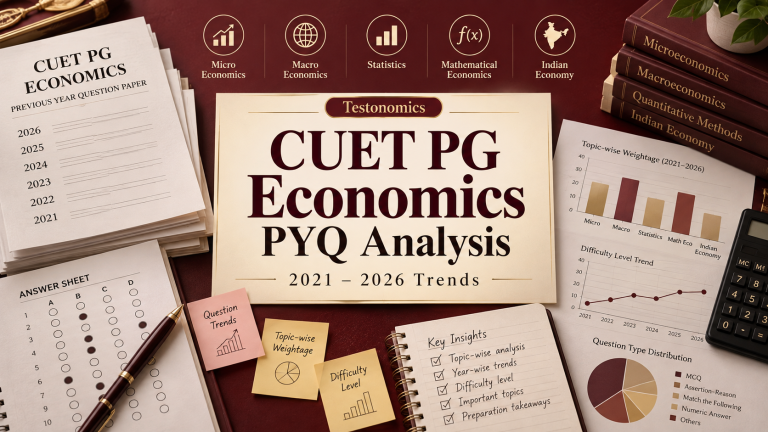
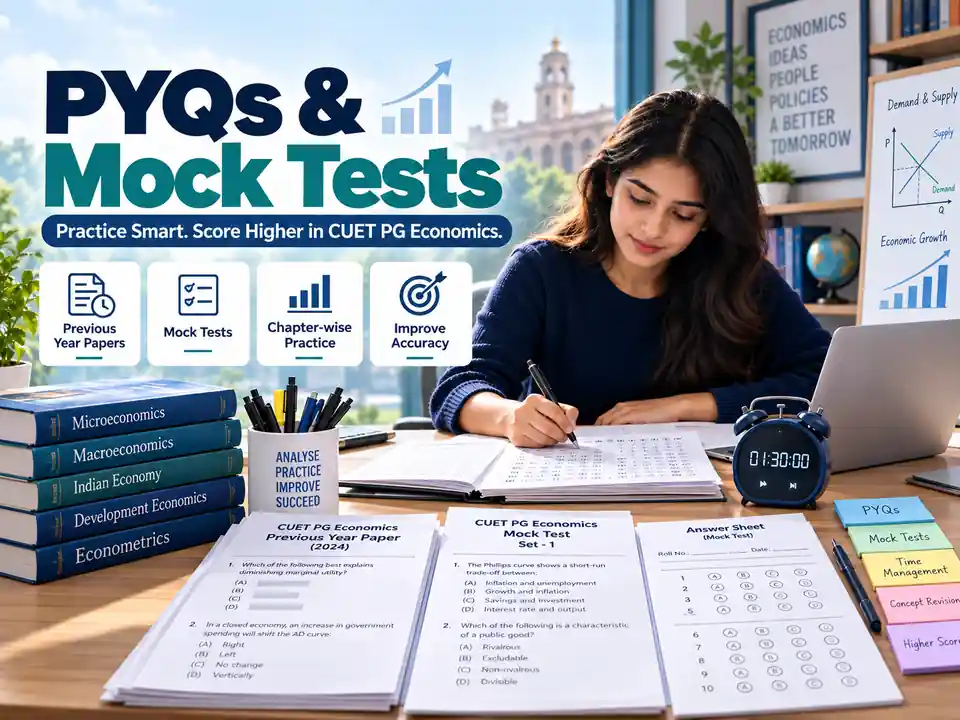
Previous papers show you what NTA has actually asked, not what a textbook author thinks is important. Work through the available CUET PG Economics PYQs and previous year papers after you have covered a reasonable part of the syllabus.
Do not use PYQs only as a score-checking exercise. When a question surprises you, identify the underlying topic and add it to your preparation list. Factual questions deserve attention too. Every year, students who are comfortable with theory and numericals can still be caught off guard by factual areas they treated as peripheral.
3. Revise through mixed practice
Once the first round of coverage is complete, stop revising subjects only in isolated blocks. Mixed practice is closer to the actual examination environment and forces your mind to switch quickly between theory, calculation and factual recall.
4. Use mocks to improve decision-making
Mock tests are not useful only because they imitate an exam. A good mock forces you to make choices under time pressure, exposes weak areas and helps you learn when to move on from a difficult question. You can explore the CUET PG Economics Mock Test Series when you are ready to add structured full-length practice.
Which books are useful for CUET PG Economics?
There is no single book that neatly covers every part of the CUET PG Economics syllabus at the right depth. For most students, the better strategy is to use a small set of standard sources and then practise objective questions.
Our CUET PG Economics Booklist explains which books are useful for different subjects and, equally importantly, where you should avoid over-reading. The purpose of a booklist is not to collect more resources. It is to reduce uncertainty about what to study from where.
If you are preparing simultaneously for IIT JAM Economics, there will be substantial overlap in foundational Economics and quantitative preparation, but the exam patterns and emphasis are not identical. Use the overlap intelligently rather than assuming that one preparation plan automatically fits both exams.
CUET PG Economics and MA Economics admissions
For many students, the real goal is not simply to “clear CUET”. The goal is admission to a strong MA or MSc Economics programme. That distinction matters because admission rules are set by individual universities and can differ in eligibility, programme mapping, cut-offs, counselling and other requirements.
This is why students searching for CUET PG MA Economics should track both the NTA examination process and the admission pages of the universities they are targeting. CUET provides the test score, but university-specific admission requirements still matter.
We will also build separate university-focused guides for students searching for questions such as how to get admission to Delhi School of Economics, JNU, IGIDR, BHU and other MA Economics programmes. Those pages will explain the admission route, eligibility and how each institution uses the relevant entrance score. This hub will serve as the starting point connecting those university guides.
If you are still comparing different MA Economics entrance exams, it can also be useful to understand where CUET overlaps with other entrances and where preparation needs to diverge.
A practical preparation roadmap
If you are beginning several months before the exam, a sensible sequence is:
- Map the syllabus: identify familiar and unfamiliar areas.
- Build core concepts: cover theory and quantitative foundations before attempting large volumes of MCQs.
- Start topic-wise questions: practise soon after studying a topic so that gaps become visible early.
- Analyse PYQs: understand recurring themes, depth and the kinds of factual or numerical questions that appear.
- Revise actively: use short notes, formula sheets, error logs and repeated questions rather than passive rereading.
- Add full-length mocks: once coverage is reasonably broad, practise under timed conditions and analyse every test.
Students who prefer a month-by-month structure can use the dedicated 2027 study-plan article when it is published. It will break this broad roadmap into monthly targets without duplicating the detailed preparation guide.
Should you take coaching or prepare on your own?
Self-study can work well if you already have a sound undergraduate foundation, can identify appropriate resources and are disciplined about practice and revision. Coaching is more useful when you need structure, topic prioritisation, regular testing or help filling conceptual gaps.
The question is therefore not whether coaching is universally necessary. Ask what problem you are trying to solve. If the main issue is lack of practice, a test series may be enough. If you need guided coverage of the syllabus, a more structured CUET PG and IIT JAM Economics course may be more appropriate.
At Testonomics, the role of the course and test series is to provide that structure without replacing the student’s own reading, revision and problem-solving.
CUET PG Economics 2027: what should you do next?
If you are starting now, do not begin by collecting dozens of resources. First read the syllabus, assess your current level and create a realistic coverage plan. Then use PYQs to calibrate the depth of preparation and add mocks once your syllabus coverage is broad enough.
For most students, the next useful pages are:
- CUET PG Economics Syllabus
- CUET PG Economics Preparation 2027
- CUET PG Economics PYQs and Previous Year Papers
- CUET PG Economics Books
- CUET PG Economics Mock Test Series
Use this hub as your reference point whenever you need to decide what to study next. As more Testonomics guides are added on important topics, study plans and university admissions, they can be connected back here so that the entire CUET PG Economics preparation path remains easy to navigate.
Preparing for MA Economics entrance exams?
Join the Testonomics MA Economics Telegram Channel for CUET PG MA Economics, IIT JAM Economics, preparation resources and important updates.
Frequently Asked Questions
Official references: Exam structure checked on 26 June 2026 against the NTA CUET (PG) 2026 Information Bulletin. See the official CUET PG Information Bulletin and the official NTA Common-paper syllabus index, where Economics is listed as COQP10.