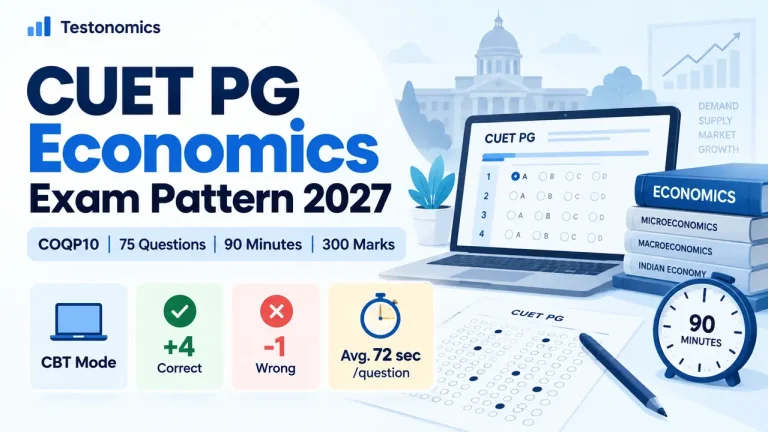
COQP10 is the CUET PG Economics paper code. Based on the latest confirmed 2026 pattern, the exam has 75 MCQs in 90 minutes, for a maximum of 300 marks. Use this quick reference for the marking scheme, practical timing, admission checks and the exam process.
The 2027 bulletin may change dates or rules; check the official NTA CUET PG portal when it is released.
CUET PG Economics Exam Pattern at a Glance
| Paper code | COQP10 (Economics) |
|---|---|
| Mode | Computer-Based Test (CBT) |
| Questions | 75 MCQs |
| Duration | 90 minutes |
| Maximum marks | 300 |
| Marking | +4 correct · −1 incorrect · 0 unattempted |
The Economics paper is subject-specific. NTA lists Economics as COQP10; use its official syllabus when checking what to study.
Is 90 Minutes Enough for 75 Questions?
The average is 72 seconds per question. For a well-prepared candidate, this is generally manageable: many factual, definition-based and concept-recognition questions take only seconds when you know the answer. Use the time saved for numericals and harder concepts.
Weak preparation costs time because you have to reconstruct concepts or choose among unfamiliar options. Do not get stuck. If your answer or calculation does not match the options, mark the question for review, move on and return later. The 72 seconds is an average, not a rigid limit for each question.
What Types of Questions Appear?
Expect a mix of concepts, definitions, numericals, mathematical and statistical applications, economists and their books, chronology, and Indian Economy facts. Prepare the whole CUET PG Economics syllabus. PYQs show past question styles, but relying only on them can leave gaps.
Our subject guides for Microeconomics, Macroeconomics, Mathematical Economics, Statistics and Indian Economy will cover the depth needed in each area.
Marking Scheme and Attempt Strategy
Score = 4 × correct answers − wrong answers. For example, 50 correct and 10 wrong yield 190 marks.
Answer questions you know and move ahead. Mark workable but time-consuming questions for review. Avoid spending early minutes on a pure guess. We will cover attempts, elimination and negative marking in a dedicated time-management guide.
Check Eligibility at Each University
A COQP10 score does not make you eligible for every M.A./M.Sc. Economics programme. Shortlist the universities and colleges you want, then check each programme’s eligibility, accepted paper code and admission process separately. Requirements for undergraduate subjects, Mathematics or credits may differ. NTA’s participating-university pages are a starting point; use each university’s current admission prospectus for the final conditions.
CUET PG 2026 Timeline: A Guide for 2027
Dates change by cycle. These 2026 milestones show the usual order; do not treat them as 2027 dates.
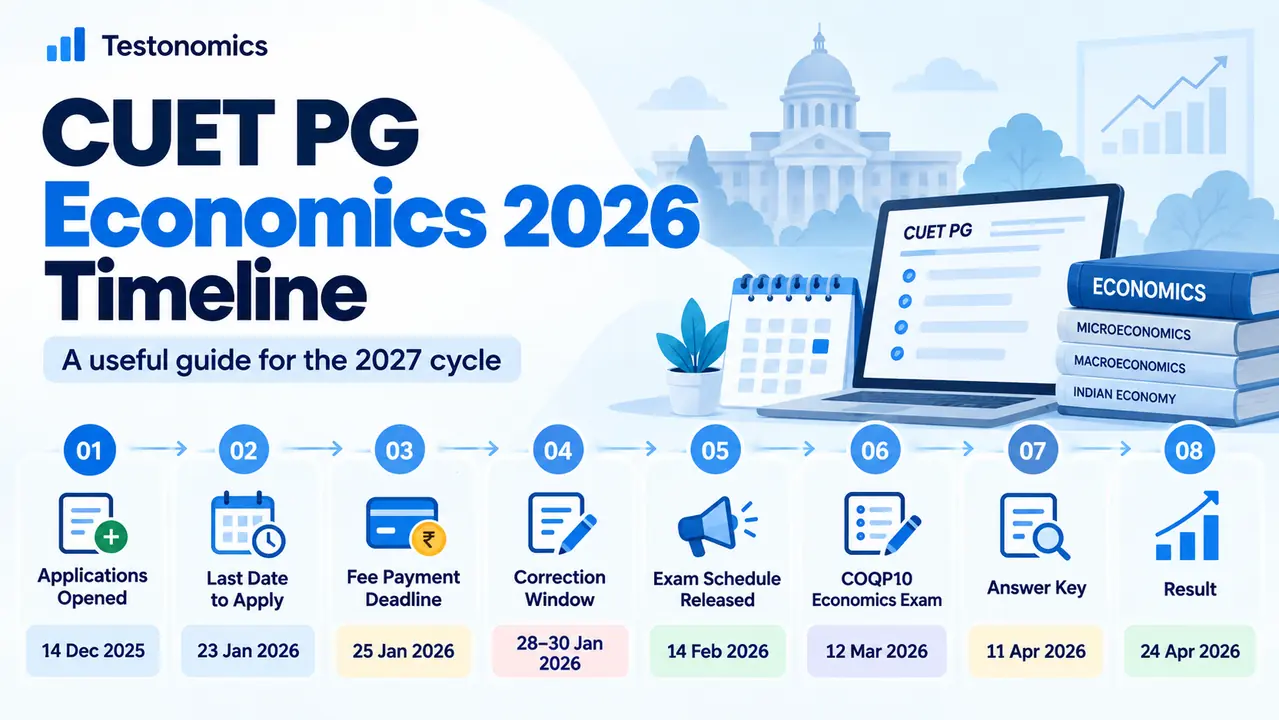
| Stage | 2026 cycle |
|---|---|
| Applications opened | 14 December 2025 |
| Extended last date to apply | 23 January 2026 |
| Fee payment deadline | 25 January 2026 |
| Correction window | 28–30 January 2026 |
| Subject schedule released | 14 February 2026 |
| Economics (COQP10) exam | 12 March 2026, 12:30–2:00 PM |
| Economics admit card released | 7 March 2026 |
| Provisional answer key | 11 April 2026 |
| Result | 24 April 2026 |
Follow NTA’s CUET PG notices for 2027 dates. The 2026 subject schedule and result notice illustrate how the stages were announced.
Exam City, Admit Card and Reporting Time
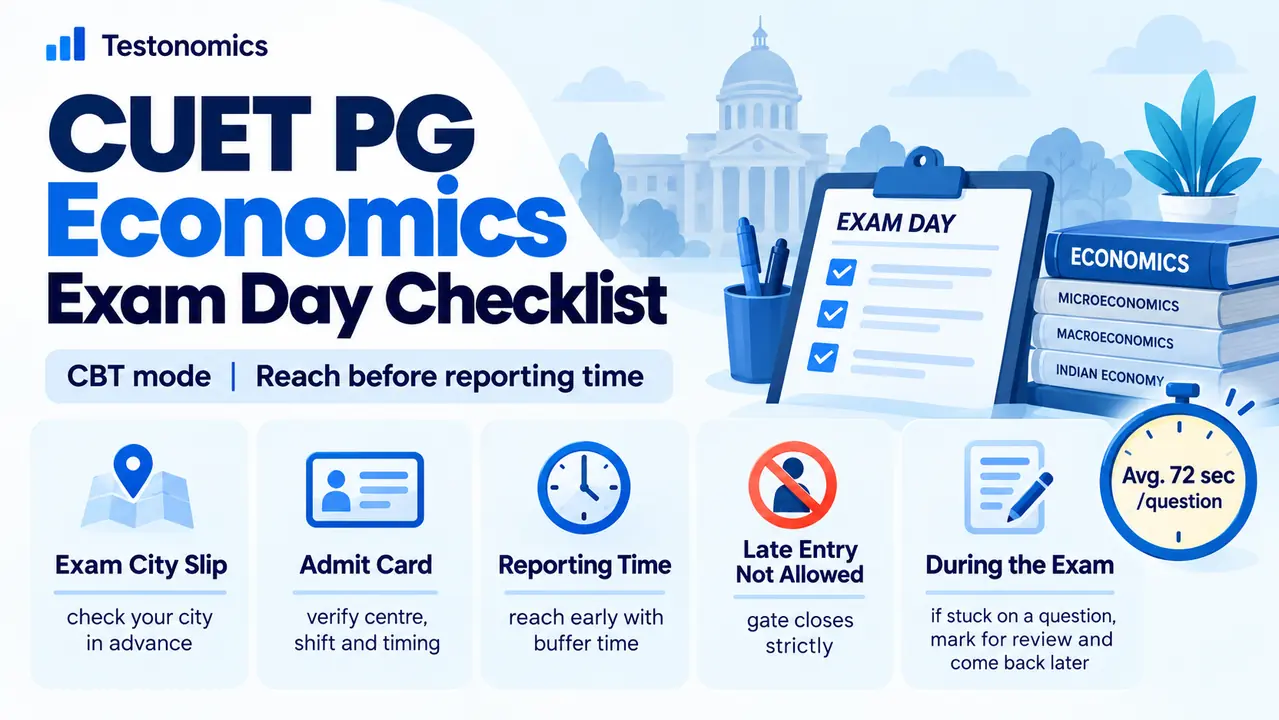
CUET PG is a CBT at an examination centre. NTA may issue an exam-city slip first; it tells you the city, not the full centre address. Your admit card gives the centre, shift, reporting time and gate-closing time. For the 12 March 2026 Economics exam, the relevant admit card batch was released on 7 March. Check NTA regularly instead of assuming a fixed release interval.
Reach the centre before the reporting time, with a comfortable buffer. Entry after gate closing is refused—even a small delay may cost you the exam. Check the route to your centre beforehand and follow the document and identity instructions on your admit card.
Prepare for the CBT Format
Build concepts across the syllabus, then practise MCQs, analyse PYQs, take timed tests and make time for repeated revision. Our PYQ analysis helps you study what past papers reveal without treating them as the entire syllabus.
Practise navigating on-screen questions, marking for review and tracking time. Use the Testonomics CUET PG Economics Test Series for 90-minute mocks, then review knowledge gaps, calculation errors and time lost. For a broader plan, see the six-month study plan.
If you are also preparing for IIT JAM Economics, much of the conceptual foundation overlaps, but practise each exam’s own question style and pattern.
Keep up with MA Economics entrance updates
Join our Telegram channel for CUET PG Economics preparation updates and resources.