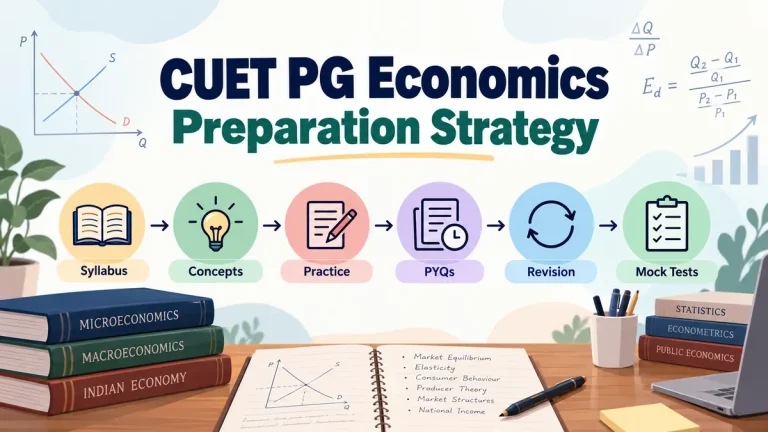
CUET PG Economics preparation becomes much easier once you stop treating the syllabus as a long reading list. The real task is to decide what to study first, how deeply to study it, when to begin questions, and how to keep earlier topics from fading while you move ahead. Many candidates use this preparation as part of a broader MA Economics entrance plan, especially when comparing CUET PG MA Economics with IIT JAM Economics.
If you want the short answer, a sound CUET PG Economics preparation strategy does four things at the same time: it builds concepts, introduces question practice early, brings older material back through active revision, and uses PYQs and mock tests to decide what needs attention next.
This guide explains how to prepare for CUET PG Economics 2027 from different starting points. It is the broad preparation page in our CUET PG Economics series. If you prefer a calendar, a CUET PG Economics study plan for 2027 can translate this framework into month-by-month milestones. For subject-wise syllabus coverage, books, PYQs and testing, you can use the linked resources as you reach those stages.
On this page
- Start with a diagnostic
- Know the paper
- Map the syllabus
- Choose a logical subject order
- Use the four-step method
- Start question practice early
- Use PYQs as evidence
- Build revision into the plan
- Keep an error log
- Introduce mock tests at the right time
- Choose the right topic depth
- Use books selectively
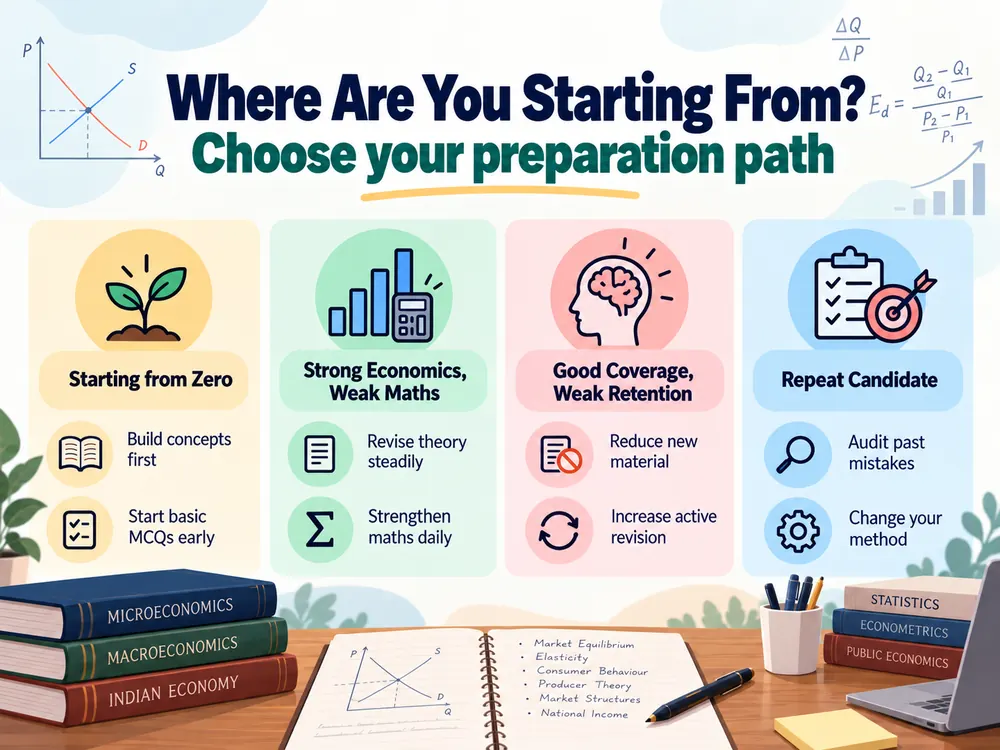
- Adjust strategy to your starting level
- Prepare through self-study
- Avoid common preparation mistakes
- Use the complete preparation framework
CUET PG Economics preparation at a glance
- Diagnose your starting level before making a timetable
- Build concepts in a logical subject order
- Start MCQs and PYQs while learning, not after the syllabus ends
- Use revision and mocks as a feedback loop
1. Start Your CUET PG Economics Preparation with a Diagnostic
Before making a timetable, find out what you already know. A BA Economics student who is comfortable with Microeconomics but slow in Mathematics needs a different first month from a candidate who is encountering several topics for the first time.
| Your present position | What to prioritise first |
|---|---|
| Strong Economics, weak Mathematics or Statistics | Keep theory in revision while strengthening quantitative foundations consistently. |
| Comfortable with Mathematics but weak Economics theory | Build Microeconomics and Macroeconomics systematically before increasing mixed practice. |
| Studied most subjects earlier but forgotten them | Move quickly towards retrieval, revision and question practice. |
| Starting substantially from zero | Give concepts more time, but introduce basic MCQs from the beginning. |
| Repeat candidate | Audit earlier mistakes before adding more material. |
A useful diagnostic is to attempt a representative set of CUET PG Economics previous year questions. The score is less important than the pattern of mistakes. Mark questions as: knew it, forgot it, misunderstood it, could not calculate it, or had never studied it. That classification gives you a much better starting plan than a raw percentage.
2. Know the Paper You Are Preparing For
Economics is the NTA paper code COQP10. Under the current CUET (PG) structure used for 2026, each paper has 75 questions in 90 minutes. Each correct answer carries 4 marks and each incorrect answer carries a penalty of 1 mark. That format matters for preparation because you need both subject knowledge and fast retrieval under time pressure.
The official syllabus should remain your boundary. Use the CUET PG Economics Syllabus page to convert that boundary into a topic-wise study map.
| Ability | What it looks like in preparation |
|---|---|
| Conceptual understanding | You can explain why a result follows and distinguish it from a closely related idea. |
| Recall | You can retrieve definitions, assumptions, formulas and factual information without reopening your notes. |
| Application | You can solve conceptual, numerical and mathematical questions accurately within a limited time. |
3. Map the Syllabus Before You Choose Resources
Do not begin with whichever book or playlist happens to be open in front of you. First classify the syllabus into three groups: strong, familiar but weak, and new. Then choose resources to solve those specific problems.
This also prevents a common planning error: repeatedly revising comfortable topics while Mathematics, Statistics or unfamiliar parts of Indian Economy remain untouched.
The syllabus itself is not the ideal study order. Economics is interconnected. Consumer theory becomes easier when the relevant mathematics is comfortable. Macroeconomic models make more sense when equilibrium reasoning is clear. Statistics improves mainly through repeated application. Your order should therefore follow the logic of learning, not simply the order in which topics appear in the syllabus PDF.
4. Choose a Logical Subject Order
Build Microeconomics and Mathematical Methods early
Microeconomics trains optimisation, equilibrium reasoning, production, costs, market structure and welfare analysis. Mathematical Methods gives you the tools needed to work with many of those ideas. If Mathematics is weak, postponing it usually makes later preparation harder.
Add Macroeconomics once the foundation is stable
For each macro model, learn more than the final diagram. Ask: What are the assumptions? What determines equilibrium? Which variable shifts which curve? What happens to output, interest rates, prices or employment when a policy variable changes?
For example, when revising the IS-LM framework, do not stop at drawing two curves. Ask what happens when money supply increases with the price level held fixed, why the LM curve shifts, and how the result depends on the slopes of the curves. A question can test the same model through a diagram, a verbal statement or a comparative-static result.
Treat Statistics as a problem-solving subject
A formula that looks familiar is not yet usable knowledge. After learning a method, solve enough questions to become comfortable choosing the correct formula, carrying out the calculation and interpreting the result.
Prepare Indian Economy with a separate recall system
Indian Economy combines economic reasoning with institutions, chronology and factual material. Separate enduring concepts from facts that need active revision. A reading-only method is particularly weak here because recognition while reading can create the illusion of recall. Once the broad framework is clear, subject-specific guides on Microeconomics preparation, Macroeconomics preparation, Mathematical Methods, Statistics preparation and Indian Economy preparation can take over from this general strategy.
5. Use a Four-Step Method for Every Topic
For most topics, use the same basic cycle: Concept → Application → Questions → Revision.
Suppose you are studying consumer theory. First understand preferences, the budget constraint and utility maximisation. Then work through the graphical or mathematical application. Next solve questions that change assumptions or ask about related results. Finally, return to the topic after a gap and try to reproduce the key logic without looking at your notes.
A topic is not complete because you watched a lecture or read a chapter. It is much closer to complete when you can explain the central idea, recognise its assumptions, solve a standard application, distinguish it from neighbouring concepts and retrieve it again several days later.
6. Start Question Practice Before the Syllabus Is Finished
A weak preparation plan separates “studying” and “question solving” into two distant phases. Question practice should begin while you are learning because questions expose gaps that passive reading often hides.
Early in your CUET PG Economics 2027 preparation, concept-building may take most of your time. Even then, add a small number of topic-wise MCQs. As coverage improves, increase mixed-subject questions, PYQs and eventually full mock tests. The direction should gradually shift from learning Economics to retrieving and applying Economics.
7. Use CUET PG Economics PYQs as Evidence
PYQs tell you how the syllabus has actually been tested. They reveal the kinds of conceptual distinctions, numericals and factual areas that have appeared, and they help you discover weaknesses in your own preparation.
Use the CUET PG Economics PYQ and Previous Year Papers collection systematically. Do not memorise only the correct option. Treat the topic behind each question as the real unit of preparation.
If a PYQ tests one result from welfare economics, for instance, revise the surrounding concepts and ask how the examiner could test the same topic differently. If you encounter a question from an unfamiliar area, trace it back to the syllabus and decide whether it has exposed a genuine gap. A topic-wise CUET PG Economics PYQ analysis can then help you see which areas recur across papers and where the form of questioning changes, without treating past frequency as a substitute for the official syllabus.
8. Build Revision into the Plan from the Beginning
In a broad syllabus, forgetting is as important a problem as initial learning. Revision therefore cannot be reserved for the final few weeks.
Make it active. Before reopening your notes, try to reproduce a graph, list the assumptions of a model, write the formula, recall a conceptual distinction or state the relevant fact. What you fail to retrieve tells you what deserves another revision cycle.
As the months pass, your revision material should become shorter. Detailed notes can gradually be compressed into formula sheets, model summaries, lists of conceptual confusions, factual revision sheets and an error notebook. A dedicated CUET PG Economics revision strategy can later organise how often to revisit concepts, formulas, graphs and factual material.
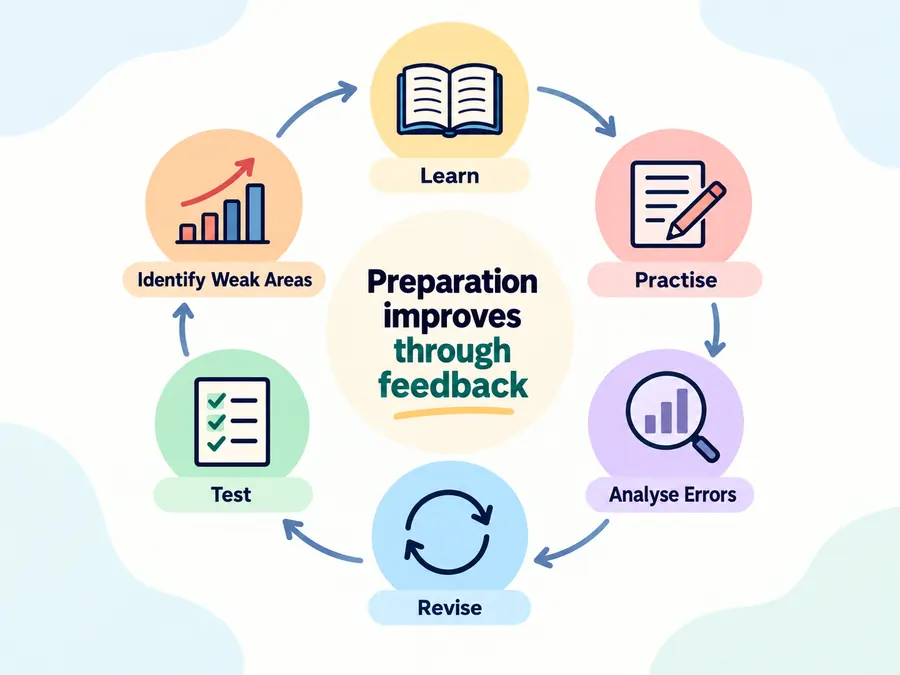
The core learning cycle
9. Keep an Error Log That Explains Why You Lost the Question
| Type of error | What it tells you |
|---|---|
| Conceptual error | Relearn or clarify the topic. |
| Recall error | The topic needs another active revision cycle. |
| Calculation error | Practise the procedure and checking discipline. |
| Misreading the question | Work on question-reading and attention. |
| Confusion between close options | Strengthen the distinction between related concepts. |
| Guessing error | Review your elimination and risk-taking rules. |
| Time-pressure error | Add timed mixed practice. |
This turns a vague conclusion such as “I am weak in Macroeconomics” into something actionable. You may discover that your actual problem is much narrower, such as repeatedly forgetting the assumptions of a few models or making sign errors in numerical questions.
10. When Should Mock Tests Enter Your CUET PG Economics Preparation?
Full mocks become useful once enough of the syllabus has been covered for the score to diagnose performance meaningfully. Before that, use topic-wise and mixed-subject tests.
As the examination approaches, mocks should test more than memory. They combine subject switching, time allocation, difficult-question judgement, accuracy and recovery after a mistake. A mock is incomplete until you have analysed the wrong, guessed and unusually slow questions. Once full-length testing becomes regular, a CUET PG Economics mock test strategy can help you separate knowledge gaps from timing, accuracy and attempt-order problems.
If you already have reasonable syllabus coverage and primarily need unseen questions and structured exam practice, see the CUET PG Economics Mock Test Series.
11. Do Not Prepare Every Topic to the Same Depth
The answer to a broad syllabus is neither superficial coverage of everything nor postgraduate-level depth in one narrow area. Aim for exam-relevant depth with conceptual completeness.
For an important model, that may mean knowing the assumptions, mechanism, equilibrium, diagram or mathematical structure, main comparative-static results and economic interpretation. For a factual area, the preparation method may be a concise recall sheet. For a numerical topic, completion means being able to solve representative applications accurately.
12. Use Books Selectively
There is no single book that is equally useful for every part of the syllabus. Use a book to solve a specific problem: understand a concept better, see a formal derivation, practise additional questions or strengthen a weak subject.
Avoid collecting several books for the same topic and reading none of them carefully. Our CUET PG Economics Booklist gives subject-wise resource suggestions.
13. Adjust the Strategy to Your Starting Level
| Candidate | Main approach |
|---|---|
| Starting almost from zero | Give concepts more initial time, but begin basic MCQs alongside learning. |
| BA Economics student with reasonable concepts | Diagnose weak areas quickly and move earlier towards questions and revision. |
| Candidate weak in Mathematics | Begin quantitative foundations early and practise consistently rather than intensively at the end. |
| Candidate with good coverage but poor retention | Reduce new material and increase active revision and mixed practice. |
| Repeat aspirant | Use past mistakes and PYQs to identify exactly what must change this time. |
| College student preparing alongside classes | Use a sustainable weekly system rather than depending on occasional long study sessions. |
14. Can You Prepare for CUET PG Economics Through Self-Study?
Yes. Self-study can work if you can identify the correct syllabus coverage, choose appropriate resources, maintain a consistent routine and diagnose your own mistakes. The useful question is not simply whether coaching is necessary. Ask which parts of the preparation system you can execute reliably on your own and where you repeatedly get stuck.
If the main problem is structured teaching and syllabus coverage, see the CUET PG Economics online coaching course. If your concepts are already reasonably strong and you mainly need unseen questions, feedback and exam-oriented practice, the CUET PG Economics Test Series is the more relevant option.
15. Common Preparation Mistakes to Avoid
Watch for a cycle in which preparation becomes lecture → notes → next topic → forgotten topic. Replace it with learn → solve → analyse → revise → solve again.
Also avoid relying only on PYQs, postponing Mathematics or Statistics because they feel difficult, ignoring factual questions, adding new books when revision is the real problem, and taking mock after mock without analysing why marks were lost.
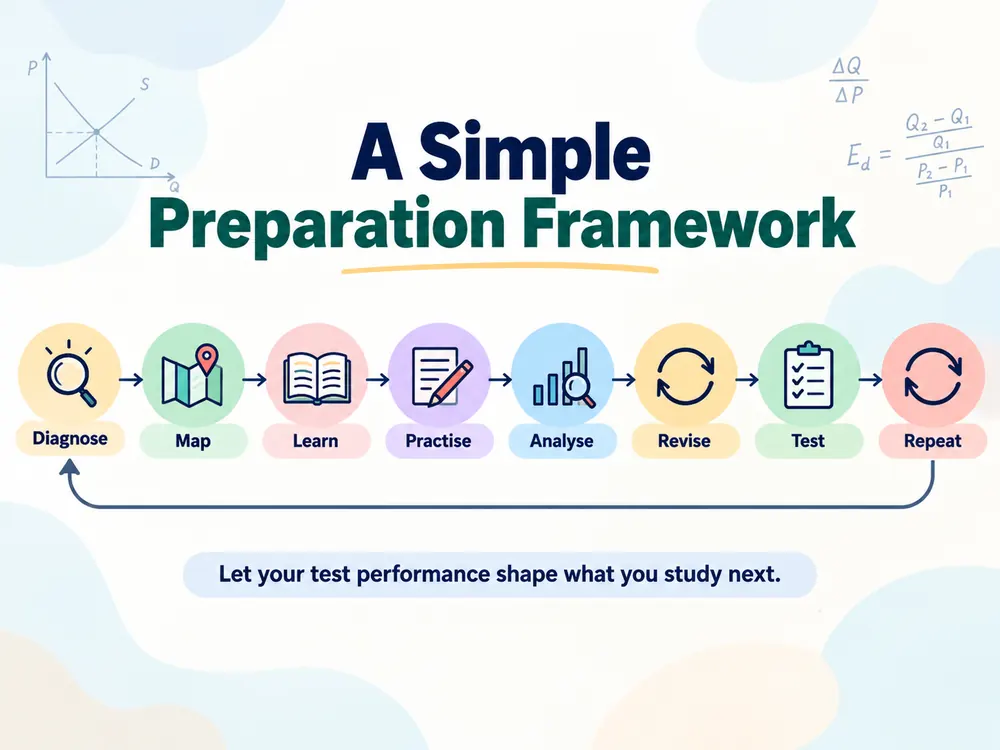
16. A Simple CUET PG Economics Preparation Framework
If you want one process to remember, use this:
Diagnose → Map → Learn → Practise → Analyse → Revise → Test → Repeat.
Diagnose your starting level. Map the syllabus. Learn concepts systematically. Practise while learning. Analyse PYQs and your own errors. Revise older material repeatedly. Test yourself under mixed and timed conditions. Then let test performance decide what you study next.
That is the core of effective CUET PG Economics preparation. The aim is not merely to finish the syllabus. By the time you sit the exam, the important material should have been understood, practised, revised and tested.
Targeting DSE, JNU, IGIDR or another MA Economics programme?
Many candidates prepare for the exam with a particular programme in mind. If your goal is admission to Delhi School of Economics, JNU, IGIDR or another MA Economics programme, treat admission research as a separate task from exam preparation.
Different MA Economics entrance routes can overlap in syllabus, but university eligibility and admission rules need to be checked separately. The useful next-step resources are guides to universities accepting CUET PG Economics, MA Economics entrance exams in India, and CUET PG Economics vs IIT JAM Economics. University-specific admission guides can then cover DSE, JNU and IGIDR in detail.
Preparing for MA Economics entrance exams?
Join the Testonomics MA Economics Telegram Channel for CUET PG MA Economics, IIT JAM Economics, preparation resources and important updates.
Frequently Asked Questions
Official references: Exam structure checked on 27 September 2026 against the NTA CUET (PG) 2026 Information Bulletin. See the official CUET PG Information Bulletin and the official NTA Common-paper syllabus index, where Economics is listed as COQP10.