Testonomics Research Analysis • 2021–2026
CUET PG Economics PYQ Analysis: What the 2021–2026 Papers Tell Us
This CUET PG Economics PYQ analysis studies 525 question slots across seven paper forms to identify changing question formats, approximate subject distribution, recurring themes and the preparation lessons that matter for CUET PG MA Economics candidates.
The goal is not to invent a fixed NTA “weightage”. It is to understand the paper well enough to prepare more intelligently.
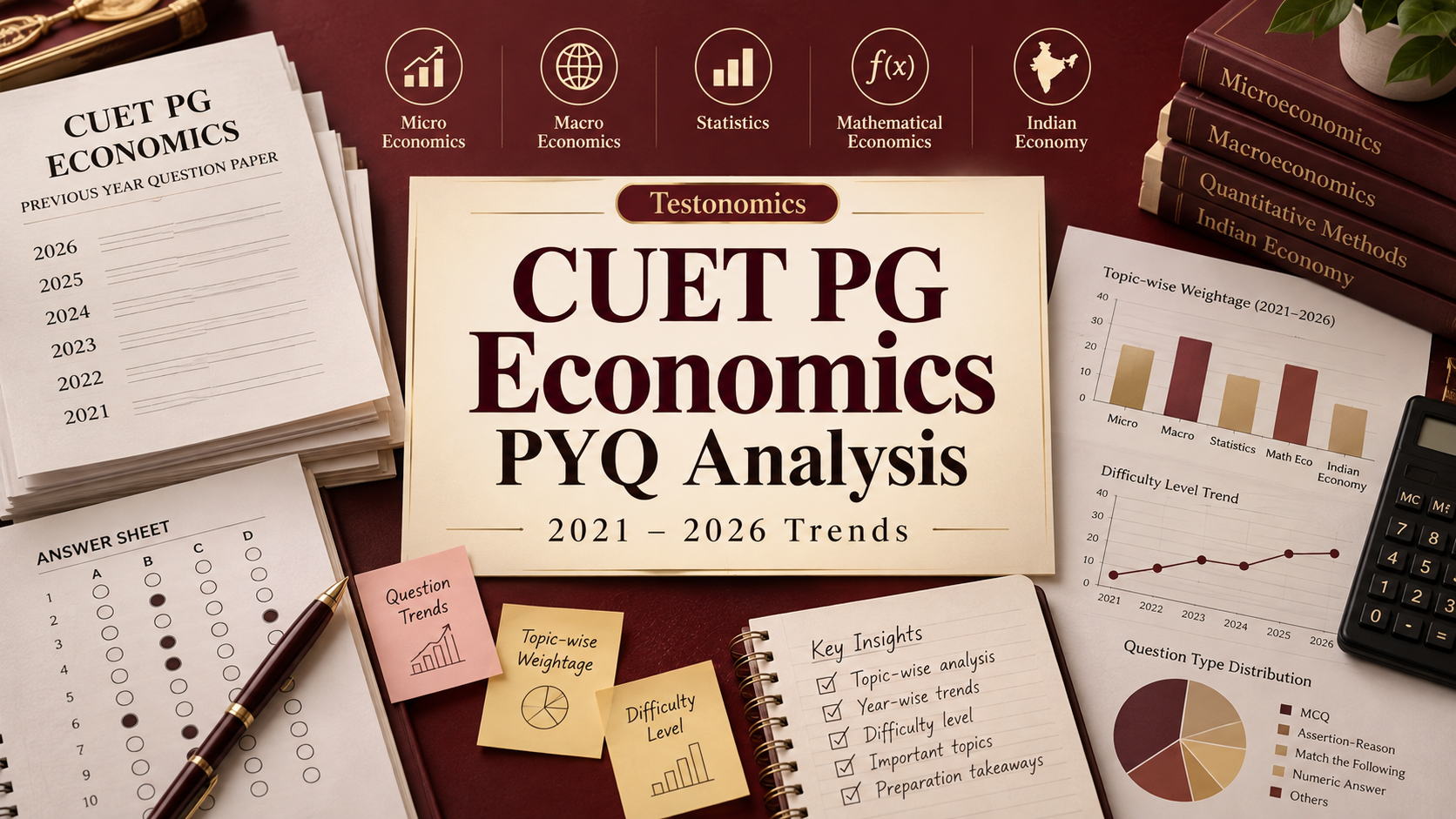
CUET PG Economics PYQ analysis is most useful when it goes beyond counting repeated chapters. Across the 2021–2026 papers, the exam repeatedly returns to core economics and quantitative methods, but the way those ideas are tested has changed considerably.
The clearest trend is this: preparation based only on short factual MCQs is increasingly risky. Recent papers combine direct questions with matching, sequencing, assertion–reason, multi-statement and numerical formats. The 2026 paper is the strongest example in our dataset: 35 of its 75 question slots were coded as structured multi-part formats.
This analysis covers seven paper forms and 525 question slots: 2021, 2022, both 2023 shifts, 2024, 2025 and 2026. The objective is not to invent an “official weightage”. It is to understand what the PYQs actually tell a serious 2027 candidate.
Keep the CUET PG MA Economics Syllabus beside you while reading this analysis, and use the CUET PG Economics PYQs to verify the examples paper by paper.
CUET PG Economics PYQ Analysis: Four Key Takeaways
Question format has changed
Recent papers increasingly combine direct MCQs with matching, sequencing, assertion–reason and multi-statement formats.
Subject weightage moves
The broad NTA syllabus areas recur, but their share changes sharply from one paper to another.
Facts matter across subjects
Chronology, books and authors, institutions, economists, theories and events can matter well beyond Indian Economy.
Relative performance matters
An ‘easy’ or ‘difficult’ paper matters mainly relative to competitors. Holistic preparation helps when the paper surprises everyone.
Table of Contents
- How this PYQ analysis was done
- How the question format has changed
- Approximate NTA syllabus-wise question distribution
- Topic-wise trends across the papers
- Factual vs numerical questions
- Topics that keep returning
- What changes from one paper to another
- What this means for 2027 preparation
- Why holistic preparation matters
- FAQs
How This CUET PG Economics PYQ Analysis Was Done
Dataset: 7 paper forms × 75 question slots = 525 questions.
Papers: 2021, 2022, 2023 Shift 1, 2023 Shift 2, 2024, 2025 and 2026.
Important caveat: The categories used below are Testonomics editorial categories, not official NTA topic weightages. When a question spans more than one area, it is assigned to the closest or dominant syllabus category.
Dropped questions: A dropped question can still be useful for topic and format analysis, even though it should not be used to judge the correctness of an answer key.
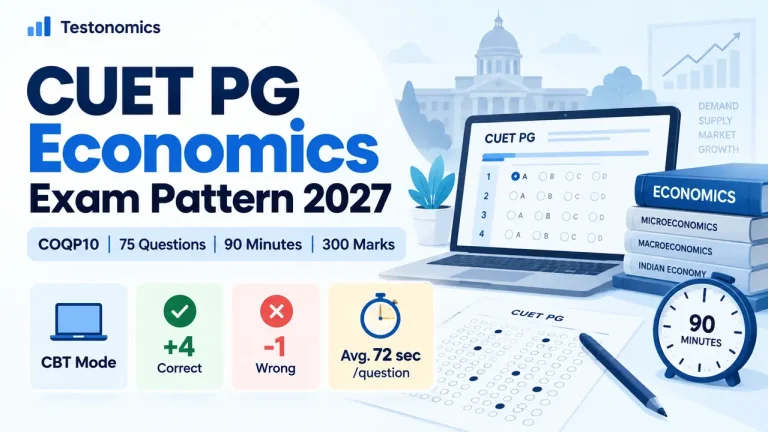
The official Economics paper code is COQP10. Its syllabus is broad, covering Microeconomics, Macroeconomics, Money and Inflation, Consumption and Investment, Open Economy models, Economic Growth, Statistical Methods, Mathematical Methods and Indian Economy.
PYQ frequency is evidence about the past, not a promise about the next paper. Use PYQs to understand coverage, depth and question style—not to delete low-frequency syllabus areas from your preparation.
How the CUET PG Economics Question Format Has Changed
We coded each question by its dominant visible format. “Structured multi-part” below combines matching, assertion–reason, sequencing/ordering and multi-statement questions.
| Paper | Direct concept / fact | Explicit numerical | Assertion–Reason | Matching | Multi-statement | Sequencing | Structured multi-part share |
|---|---|---|---|---|---|---|---|
| 2021 | 64 | 10 | 0 | 0 | 1 | 0 | 1.3% |
| 2022 | 37 | 10 | 5 | 10 | 12 | 1 | 37.3% |
| 2023 Shift 1 | 46 | 9 | 6 | 0 | 9 | 5 | 26.7% |
| 2023 Shift 2 | 33 | 12 | 8 | 7 | 10 | 5 | 40.0% |
| 2024 | 49 | 6 | 0 | 8 | 7 | 5 | 26.7% |
| 2025 | 41 | 10 | 0 | 10 | 4 | 10 | 32.0% |
| 2026 | 31 | 9 | 9 | 11 | 5 | 10 | 46.7% |
Coding note: “Explicit numerical” is a conservative tag based on questions that visibly require a calculation or mathematical operation. Formula-heavy items embedded visually can be undercounted.
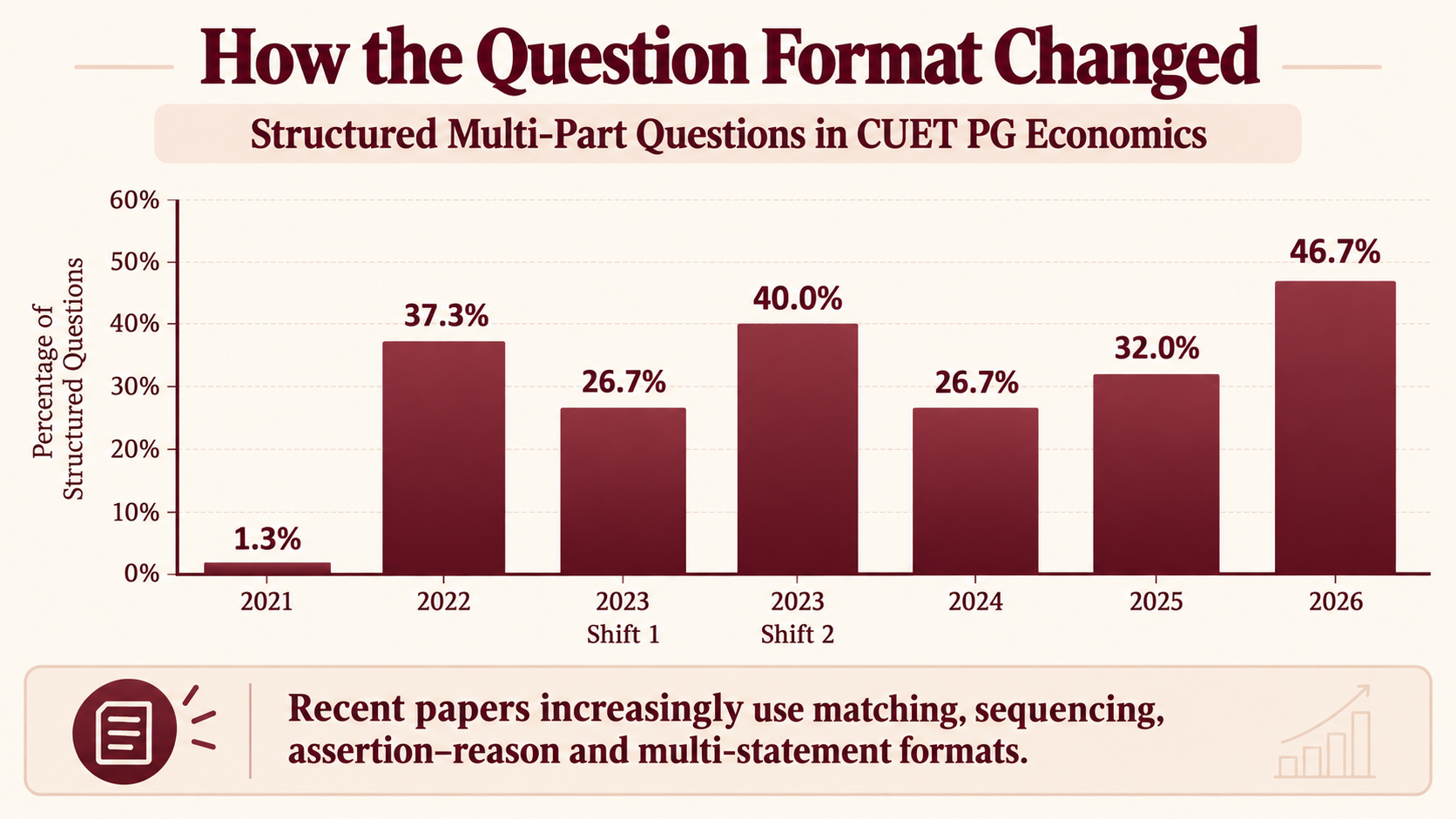
Trend 1: 2021 looks very different from the recent papers
The 2021 paper contains many short, direct questions. Its opening stretch asks about the Union Budget, employment in agriculture, the “Father of Economics”, the Economic Survey, disguised unemployment, colonial education policy and the 1991 reforms. A student who prepared only from that paper could form the wrong impression that CUET PG Economics is mainly a recall-based test.
Trend 2: From 2022 onward, the wrapper around the concept becomes more important
The 2022 paper immediately mixes theory with different styles of reasoning: elasticity, Bertrand competition, agricultural demand, rectangular-hyperbola demand and Giffen goods appear alongside matching, assertion–reason and statement-based questions. You do not merely need to “know” a concept; you need to recognise it when presented through an unfamiliar statement, list, chronology or comparison.
Trend 3: Different shifts can look meaningfully different
The two 2023 papers make this especially clear. Shift 1 begins with regression, monetary-policy instruments, concavity, the Finance Commission, colonial investment, correlation, the Gauss–Markov theorem and the primary deficit. Shift 2 begins with market failure, public goods, consumption hypotheses, Pareto efficiency, regression degrees of freedom, homogeneity and data types. Both are Economics papers, yet the mix is different enough that one shift should not become your blueprint.
Trend 4: 2025 and 2026 reward comfort with sequencing and multi-part reasoning
Sequencing questions are particularly visible in the last two papers. The 2026 paper opens by asking candidates to sequence taxation principles, then moves to an assertion–reason question on colonial “Home Charges”, followed soon by a sequence of Pigouvian correction, statements on the Phillips Curve and the evolution of money-demand theories. This rewards conceptual organisation, not isolated memorisation.
Key takeaway from this CUET PG Economics PYQ analysis: knowing a concept is no longer enough. You must be able to recognise it when NTA changes the wrapper—chronology, matching, assertion–reason, statements or an unfamiliar application.
Approximate NTA Syllabus-Wise Question Distribution
NTA organises the COQP10 Economics syllabus under seven broad headings. For this article, we classified every question in the seven supplied paper forms into the closest of those NTA headings.
How to read this table: These are Testonomics estimates, not official NTA weightages. Many questions overlap categories, so a mixed question has been assigned to its dominant syllabus area. A reasonable manual recoding can move a category by one or two questions.
Also note that NTA’s Indian Economy unit is unusually broad: it includes colonial economy, Public Economics, taxation and International Trade theories. Open Economy Models and Economic Growth sit under NTA’s Consumption and Investment Function heading. These labels therefore do not perfectly match a conventional textbook division.
| NTA syllabus category | 2021 | 2022 | 2023 S1 | 2023 S2 | 2024 | 2025 | 2026 | Rough average |
|---|---|---|---|---|---|---|---|---|
| Micro Economics | ~11 | ~16 | ~17 | ~16 | ~23 | ~14 | ~23 | ~17 |
| Macro Economics | ~12 | ~8 | ~8 | ~3 | ~7 | ~5 | ~5 | ~7 |
| Money and Inflation | ~1 | ~6 | ~4 | ~10 | ~6 | ~12 | ~13 | ~7 |
| Consumption & Investment Function incl. Open Economy Models & Economic Growth | ~2 | ~9 | ~6 | ~13 | ~6 | ~8 | ~4 | ~7 |
| Statistical Methods in Economics | ~11 | ~9 | ~13 | ~11 | ~14 | ~15 | ~8 | ~12 |
| Mathematical Methods in Economics | ~10 | ~6 | ~13 | ~14 | ~4 | ~6 | ~5 | ~8 |
| Indian Economy incl. Public Economics, taxation & International Trade theories in NTA syllabus | ~28 | ~21 | ~14 | ~8 | ~15 | ~15 | ~17 | ~17 |
Important reading tip: the value of this table lies in showing variation. It does not mean you should prepare “exactly 17 Micro questions” or “only 7 Macro questions”. Historical distribution should guide revision, not become a prediction rule.
The main lesson is not that you should prepare “17 Micro questions” or “12 Statistics questions”. The useful lesson is that the distribution moves sharply from year to year. Microeconomics and the broad Indian Economy block have been substantial across the dataset, but Money and Inflation, Statistics, Mathematics and Open Economy/Growth can become much more prominent in a particular paper.
For example, our rough coding places Money and Inflation at only about one question in 2021 but around thirteen in 2026. Mathematical Methods is approximately fourteen questions in 2023 Shift 2 but only about four in 2024. Historical weightage should guide revision without becoming a prediction rule.
For the official topic boundaries, start with the CUET PG MA Economics Syllabus. Then solve the actual CUET PG Economics PYQs to see how those syllabus headings are converted into questions.
Topic-Wise Trends Across CUET PG Economics PYQs
The papers do not support a sensible claim such as “Microeconomics will definitely carry X questions next year”. They do support a stronger conclusion: certain topic families repeatedly reappear, while the exact subtopic and question form changes.
1. Microeconomics remains structurally important
Microeconomics appears across the entire period through consumer theory, demand, elasticity, production, market structure, welfare and externalities. The 2022 paper opens with bandwagon demand, Bertrand competition, agricultural demand and a Giffen-good question; 2024 opens with a PPF trade-off, returns to scale and Bertrand equilibrium before moving to revealed preference and the Coase theorem.
Preparation implication: move between verbal intuition, graphs, simple algebra and welfare reasoning.
Our forthcoming Microeconomics preparation guide for CUET PG Economics will convert these PYQ patterns into a topic-by-topic study method, including consumer theory, production, market structures and welfare economics.
2. Macroeconomics, money and inflation recur in many forms
Earlier papers include Say’s Law, multiplier identities, national income and effective demand. Later papers test aggregate demand, money demand, the Phillips Curve, monetary transmission, inflation concepts and money-multiplier mechanics.
Preparation implication: learn macroeconomics as a connected system rather than separate definitions.
We will build a separate Macroeconomics preparation guide for CUET PG Economics showing how to connect national income, income determination, money, inflation, policy and growth rather than studying them as isolated chapters.
3. Statistics and Econometrics are not optional add-ons
Quantitative methods appear consistently: regression, correlation, Gauss–Markov, probability, geometric mean, standard error, random variables and related areas recur. Candidates whose undergraduate programme was light on quantitative methods should not leave this block for the last few weeks.
A dedicated Statistics for CUET PG Economics preparation strategy will later organise these areas into descriptive statistics, probability, sampling, correlation, regression and interpretation, with PYQ-based practice at each stage.
4. Mathematical Economics is tested through technique and interpretation
Matrices, determinants, calculus, functions, optimisation and homogeneity recur. Sometimes the operation is direct; at other times, the mathematics is embedded inside production, utility or elasticity.
Do not prepare Mathematical Economics as only a numerical subject. Definitions and properties matter too. Convexity and concavity are a good example: a strictly concave function was tested in 2023 Shift 1, another convex-versus-concave function question appeared in 2023 Shift 2, and quasi-concavity/quasi-convexity appeared again in 2025. So a candidate who practises only calculations can still lose marks on basic mathematical definitions and properties.
This foundation also helps students preparing for other MA Economics entrance exams such as IIT JAM Economics, although the exact paper style differs.
We will develop this further in a dedicated Mathematical Methods for CUET PG Economics preparation guide, covering definitions, formulas, problem solving and the conceptual traps visible in PYQs.
5. Indian Economy and Public Economics produce both factual and conceptual questions
The 2021 paper is a warning against ignoring factual preparation: Budget, employment structure, Economic Survey, unemployment, colonial policy and 1991 reforms appear early. Later papers show that the same area can be tested analytically through the Finance Commission, fiscal concepts, colonial economic history and taxation.
Preparation implication: attach facts to concepts instead of memorising isolated one-line facts.
Our planned Indian Economy preparation guide for CUET PG Economics will show how to organise factual material around themes such as the colonial economy, reforms, public finance, institutions and policy rather than memorising disconnected facts.
6. International Economics, Growth and Development remain part of the rotation
Open-economy models, balance of payments, exchange rates, trade, growth theory and development concepts recur, but not in a perfectly stable number each year. A quiet year is not a safe reason to delete the topic from your plan.
Factual vs Numerical Questions: What the Papers Suggest
Factual questions have not disappeared
Factual questions repeatedly appear on economists and theories, chronology, committees, policy measures, historical developments, institutions and Indian Economy. Recent papers also combine factual knowledge with sequencing and statement formats, making isolated memorisation less effective.
Practical factual-preparation method: maintain compact sheets for Indian Economy, economic history, institutions and committees, economists, books and authors, theories, important events and chronology. Then connect every fact to the surrounding concept instead of memorising it in isolation.
Better way to prepare facts: maintain compact factual sheets across the syllabus, not only for Indian Economy. Useful categories include economic history, institutions and committees, economists, books and authors, theories, important events and chronology. For every fact, connect it to the surrounding concept. For example, do not memorise “Home Charges” as one phrase; place it inside a colonial-economy sheet covering drain of wealth, remittances, public debt, pensions and balance-of-payments implications. Similarly, if you learn which economist wrote a particular book or which event came before another, also understand the theory, policy debate or historical sequence to which that fact belongs.
Numerical questions are persistent, but they do not dominate the whole paper
Our conservative format coding identifies roughly 6–12 explicit calculation questions in each paper. Do not treat that as official weightage: formula-heavy visual items can be difficult to classify. The preparation message is simpler—you cannot ignore numericals, and you also cannot prepare as though CUET PG Economics were a purely mathematical entrance.
The most dangerous category is the conceptual question that looks factual
Matching, assertion–reason and sequencing make the relationship between ideas more visible, but even a one-line MCQ can contain a conceptual trap. After every PYQ, ask what broader concept it represents, what nearby concept could be tested, and how NTA could rewrite the question.
Recurring Topic Families Worth Tracking
| Topic family | Examples of recurring areas | How to prepare |
|---|---|---|
| Microeconomics | Demand and elasticity, consumer theory, production, costs, market structures, welfare, externalities | Concept + graph + algebra + application |
| Macroeconomics & Money | National income, income determination, money demand/supply, inflation, Phillips Curve, policy | Build links between models |
| Statistics & Econometrics | Probability, averages/dispersion, correlation, regression, sampling, estimator properties | Short regular problem practice + interpretation |
| Mathematical Methods | Matrices, calculus, functions, optimisation, homogeneity | Definitions + technique + economic use |
| Indian Economy & Public Economics | Colonial economy, reforms, institutions, fiscal concepts, taxation, policy facts | Conceptual notes with dated facts and chronology |
| International, Growth & Development | Open economy, trade, BOP/exchange rate, growth models, development concepts | Do not drop because one paper looks light |
This is a trend map, not a priority ranking. A separate CUET PG Economics important topics article will convert the coded dataset into a transparent PYQ-based priority matrix without pretending historical frequency is official NTA weightage.
What Changes From One CUET PG Economics Paper to Another?
The question format changes faster than the core syllabus
The same economic idea can appear as a direct MCQ in one year, a statement combination in another and a match-the-list question later. Preparation has to move beyond recognising familiar wording.
The factual depth is uneven
Some papers ask basic factual questions; others go deeper into chronology, policy details or named concepts. Selective factual preparation is therefore risky.
The quantitative mix varies
Some papers feel more mathematical than others, and the two 2023 shifts themselves show meaningful variation. Use several years together rather than designing your plan around a single paper.
Exact repetition is less useful than concept repetition
The strongest value of PYQs is not memorising the correct option. If a PYQ asks one property of a model, prepare the model broadly enough to handle a different property next time.
What This Means for CUET PG Economics 2027 Preparation
1. Use the syllabus as the boundary and PYQs as the diagnostic
Start with the CUET PG MA Economics Syllabus. Then use the CUET PG Economics PYQs to see how those syllabus areas are actually converted into questions. Let PYQs show where your preparation is shallow, not which syllabus chapters you are “allowed” to skip.
2. Prepare facts and concepts together
Maintain compact factual sheets across the syllabus, not only for Indian Economy. Useful categories include economic history, institutions and committees, economists, books and authors, theories, important events and chronology. Link every fact to its surrounding concept: if you learn who wrote a book, which committee made a recommendation, or which event came before another, also understand why that fact matters economically.
3. Practise structured formats deliberately
Do not wait for full mocks to see assertion–reason, matching and sequencing questions. Build them into topic-wise practice from the beginning.
4. Keep quantitative practice continuous
Short, regular Statistics and Mathematics practice is usually more useful than a large numerical backlog left for the end.
5. Solve PYQs as topics, not as a memory exercise
For each PYQ, record the tested concept, why the distractors are wrong, and one nearby concept that could be turned into a fresh question. This is also useful for students preparing for several MA Economics entrance exams; the theoretical and quantitative base built for CUET PG MA Economics supports exams such as IIT JAM Economics, while the PYQ layer remains exam-specific.
We will also publish a dedicated guide on how to use CUET PG Economics PYQs for preparation: how to classify each question, identify the underlying concept, record errors, prepare adjacent concepts and then practise a fresh application.
6. Move from PYQs to unseen practice
PYQs show what has already been asked. After analysing them, use a structured CUET PG Economics Mock Test Series to test whether your understanding transfers to unseen applications and different question formats.
If you are still building your overall plan, begin with our CUET PG Economics 2027 guide, then read how to prepare for CUET PG Economics and the 6-month CUET PG Economics study plan. For source selection, use the CUET PG Economics booklist.
If your main gap is conceptual teaching rather than testing, the CUET PG Economics online course provides a structured route through the underlying material.
We will separately publish a CUET PG Economics revision strategy showing how to turn PYQ notes, formulas, graphs and factual sheets into a repeatable revision cycle. For students whose undergraduate foundations need much more rebuilding, our planned 15-month MA Economics entrance preparation plan will focus on deeper mastery across CUET PG, IIT JAM Economics and other MA Economics entrance exams.
Where to Go Next
Use this CUET PG Economics PYQ analysis as a diagnostic. Then move to the preparation resource that matches your current stage.
How to Prepare for CUET PG Economics
Build the overall preparation framework before going subject by subject.
6-Month CUET PG Economics Study Plan
Convert the broad strategy into a subject-by-subject timeline.
CUET PG Economics Mock Test Series
Use unseen practice to test whether your understanding transfers beyond PYQs.
Why Holistic Preparation Matters More Than Predicting the Paper
Students naturally ask whether a paper was “easy” or “difficult”, but in a competitive entrance examination that description matters mainly in a relative sense. If a paper is easy because it is predictable and most serious candidates have prepared those questions, scores tend to bunch higher and, all else equal, competitive admission cut-offs or required scores can rise. If a paper contains more unanticipated questions and is difficult for the candidate pool as a whole, competitive score requirements can move lower.
So the objective is not merely to hope for an easy paper. Your preparation matters relative to other candidates. A paper that surprises everybody can still reward the student who has prepared more broadly and loses fewer marks on unfamiliar-looking questions.
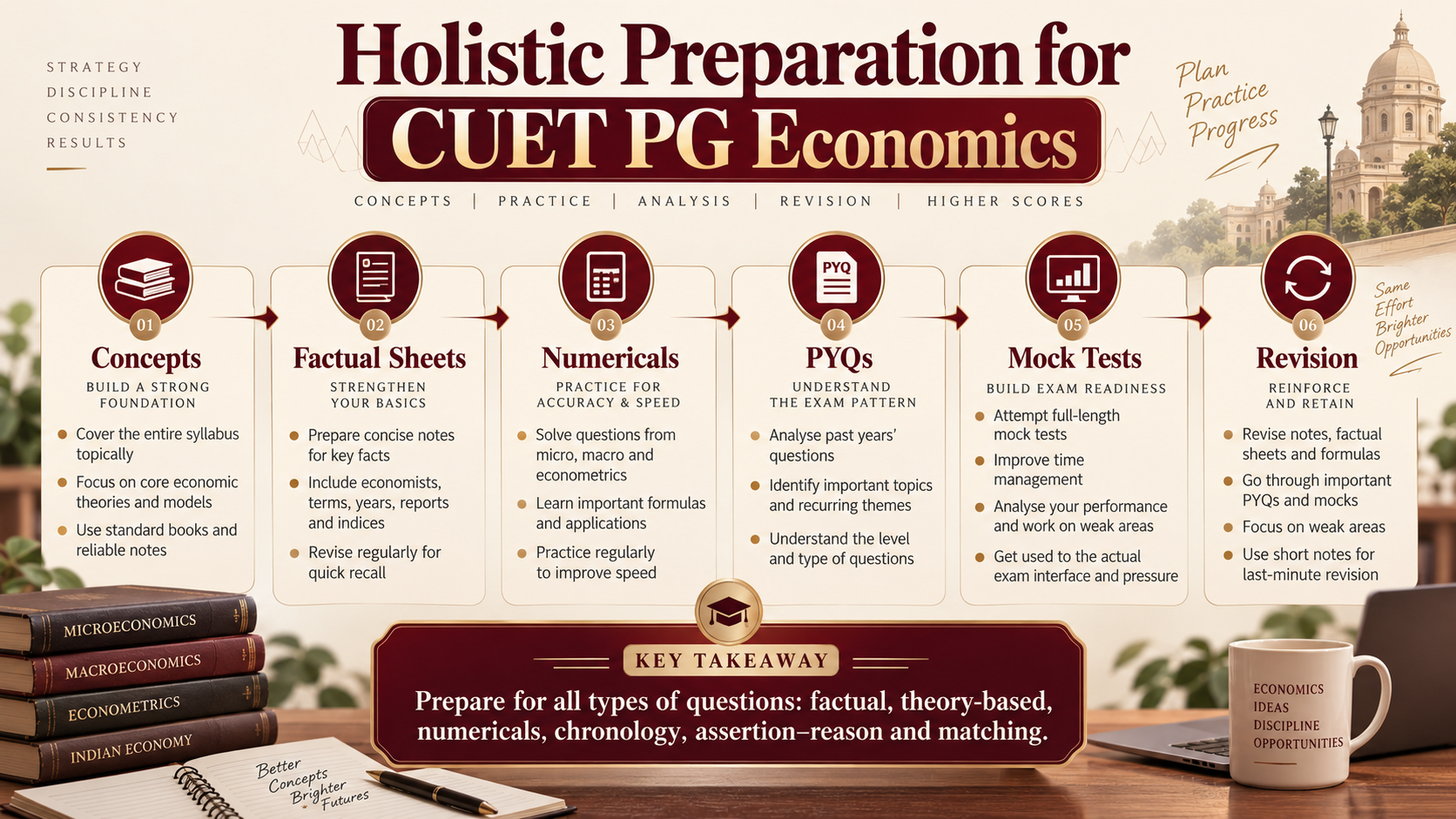
Holistic preparation, in practical terms: We do not know in advance whether NTA will emphasise a factual question, a numerical, a theory statement, chronology, assertion–reason, matching or an unfamiliar application of a familiar concept. But if you have practised all of these formats across the syllabus, you give yourself a better chance of adapting on exam day.
How Testonomics Tries to Build This Into the Test Series
Our CUET PG Economics Mock Test Series is designed to be holistic rather than built around a narrow prediction of “likely questions”. We deliberately try to cover different ways in which Economics can be tested: factual questions, numericals, theory-based questions, conceptual applications, chronology, statement combinations and other NTA-style formats.
A useful example came in the 2026 paper. NTA asked: “On recommendation of which committee, the Competition Act, 2002 was implemented?” The same question had been covered in our Test Series that year. We saw several other direct or indirect overlaps as well. The point is not that a Test Series can predict the paper. It is that the broader the pool of sensible questions we can think of and teach, the fewer areas in which a candidate is completely surprised.
Our experience designing Test Series for RBI DEPR and UGC NET Economics also helps us generate questions from different angles. UGC NET is also conducted by NTA, and in our experience themes, concepts and sometimes very similar question ideas can recur across NTA-administered Economics exams. We therefore look beyond only the latest CUET paper when thinking about how a topic can be tested.
We will separately publish a 2026 CUET PG Economics paper analysis examining what that particular paper tested, which areas were less anticipated and how its mix differed from earlier years.
Detailed Solutions Are Part of the Preparation
We do not want the solution to end with “Option B is correct.” Wherever useful, our detailed answers try to give enough surrounding information to prepare the topic, not just that one MCQ. A factual question can become a short note on the institution, committee or policy behind it. A numerical can reinforce the formula and interpretation. A theory question can explain why the correct statement works and why the other options fail.
This is also how candidates should use PYQs: treat every question as an entry point into a broader topic. The more often you turn one MCQ into a small revision note, the less dependent you become on exact question repetition.
We will also publish a separate mock-test analysis strategy explaining how to review wrong, guessed and slow questions, and an MCQ strategy for objective Economics covering distractors, statement combinations and uncertain questions.
Want regular CUET PG Economics resources?
Join the Testonomics MA Economics Entrance Telegram channel for preparation updates and resources.
Frequently Asked Questions
Editorial source note: Trend analysis is based on Testonomics copies of CUET PG Economics papers for 2021, 2022, 2023 Shift 1, 2023 Shift 2, 2024, 2025 and 2026. The question-format and NTA-category tables are Testonomics editorial codings, not NTA-issued weightage tables.